
Is React Native Good for Enterprise Mobile Apps?

Key Takeaways
- React Native is enterprise-ready in 2026 for most internal tools, dashboards, and customer-facing business apps.
- Enterprises adopt React Native for 80–90% code reuse, faster time-to-market, and lower long-term maintenance costs.
- It performs reliably at scale when paired with Hermes, Turbo Modules, modular architecture, and disciplined CI/CD practices.
- React Native supports enterprise security and compliance (GDPR, HIPAA, SOC 2) when implemented with secure storage, encryption, and zero-trust principles.
- It integrates well with ERP, CRM, microservices, middleware, and real-time systems, including offline sync support.
- React Native may not be ideal for graphics-heavy, OS-deep, or ultra-regulated applications, where native development offers more control.
- The framework is best suited for enterprises seeking scalability, adaptability, and rapid iteration without repeated rebuilds.
Introduction
Enterprise mobile platforms have become mission-critical across disparate industries in 2026. Driven by AI integration and edge computing, they are enabling seamless operations across HR and CRMs for enhanced productivity and real-time decision-making.
In practice, these platforms prioritise deep enterprise system integration over standalone apps. Thereby, fostering intelligent automation while addressing the shift to mobile-first strategies amid widespread cloud adoption.
In today’s digital landscape, speed alone no longer defines success. Scalability, security, and long-term stability matter more. Furthermore, enterprise teams care about cost control, and maintenance expenses often exceed build costs over time.
As such, in 2026, the real question has changed. Enterprises seeking B2B mobile app development services now ask whether frameworks support scalability, security, and adaptability, without constant rebuilds. Given future innovations like on-device AI, React Native often enters this discussion.
What Is React Native?
React Native is an open-source framework engineered by Meta to build cross-platform mobile apps that run natively, utilising shared code.
Launched in 2015, it empowers developers to create high-performance apps whilst reducing development time and costs compared to separate native implementations.
In practice, the framework bridges JavaScript code to native platform components via the Hermes engine. As a result, rendering true UI elements like UIKit on iOS and Android Views rather than webviews for an authentic feel and responsiveness.
To this end, React Native developers primarily employ JavaScript or TypeScript alongside React principles.
What Defines Enterprise App Development?
Enterprise app development is underpinned by five main tenets, namely:
- Scale (users, data, integrations): Enterprise apps must support thousands of concurrent users. Additionally, they should process massive data volumes in real-time, with the capacity to integrate with disparate systems, without performance loss.
- Security and compliance requirements: Enterprise apps must maintain a zero-trust architecture, end-to-end encryption, and biometric authentication to protect sensitive corporate data from breaches.
- Long-term maintainability: Enterprise app development requires modular codebases, API-first designs, and low-code extensibility. These elements enable easy updates, feature additions, and tech stack evolution over the years—without full rewrites.
- Performance and reliability: Enterprise app development must prioritize 99.99% uptime, offline functionality, and fast load times. This ensures consistent operation under heavy loads or network issues.
- Integration with complex backend systems: Enterprise apps must unify data across complex legacy systems, databases, and third-party services for streamlined workflows.
Why Enterprises Consider React Native?
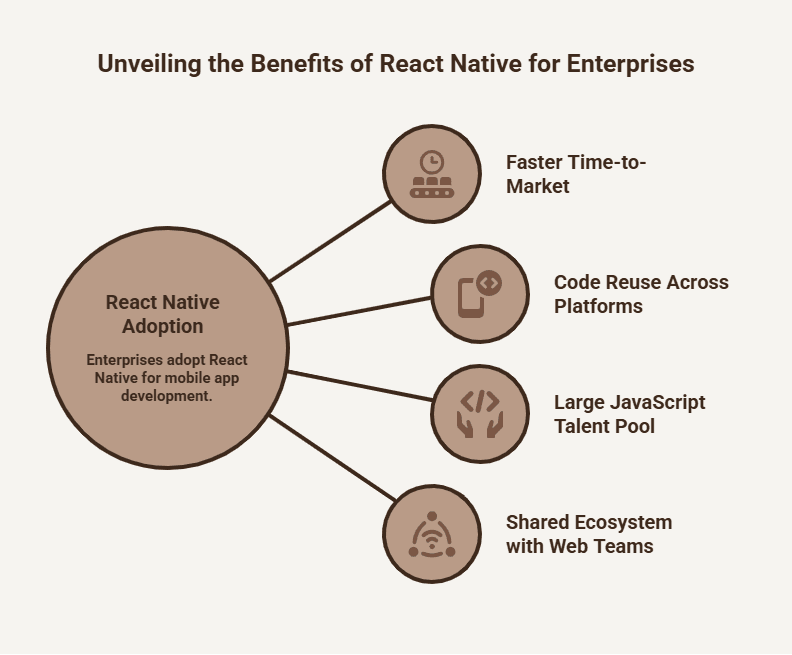
Image: React Native Benefits for Enterprises
Enterprises are increasingly adopting React Native for several reasons, such as:
- Faster time-to-market: React Native’s hot reloading and pre-built components appreciably accelerate development cycles by 30-45%.
- Code reuse across platforms: A single JavaScript/TypeScript codebase accomplishes 80-90% reusability between iOS and Android.
- Large JavaScript talent pool: The millions of React developers globally reduce hiring costs and ramp-up time.
- Shared ecosystem with web teams: Common React principles and libraries unify mobile and web development. This, in turn, fosters collaboration and consistent tooling across departments.
React Native Performance in Enterprise Environments
React Native delivers solid performance in enterprise environments. Here is an illustrative overview of its capabilities in enterprise setups:
- Runtime performance and memory handling: Its JIT (Just-In-Time) and AOT (Ahead-Of-Time) compilation cuts startup by 50% and memory by 30% while maintaining 60fps rendering in list-heavy UIs.
- Handling complex workflows and large data sets: It virtualises massive datasets efficiently, with lazy loading and pagination managing enterprise-scale data flows, without crashes.
- Native module dependency and optimisation: It offers 2-3x faster native calls, essential for CPU-intensive tasks like encryption or ML.
However, React Native features some performance trade-offs enterprises must understand. For instance, JS thread bottlenecks can cause ANR under heavy loads. Furthermore, developers must consider platform parity challenges requiring custom modules for peak optimisation.
Also Read: React Native for Fintech Mobile App Development in Malaysia.
React Native Scalability & Maintainability at Enterprise Scale
React Native scales effectively in enterprise settings via disciplined practices like modularisation and TypeScript adoption. Its inherent characteristics consequently support large teams while minimising technical debt accumulation. Let’s unpack some of its standout scalability and maintainability features, shall we?
- Codebase management for large teams: React Native enforces a consistent structure with feature-based folders, absolute imports, ESLint rules, and code reviews. This, in turn, streamlines collaboration among dozens of developers.
- Modular architecture and monorepos: It allows developers to break apps into independent feature modules with Redux Toolkit.
- Version upgrades and technical debt: React Native allows developers to adopt incremental upgrades via automated CI/CD pipelines, regular refactoring with TypeScript migration, and auditing of third-party libraries to prevent debt buildup.
- Long-term support considerations: React Native prioritises backward compatibility and offers comprehensive documentation to handle evolving platform APIs.
React Native Security & Compliance Considerations
React Native apps in enterprise environments demand rigorous security measures to protect sensitive data—at scale. It dictates leveraging best industry practices focusing on encryption, authentication, and proactive vulnerability management. Here is an illustrative overview of its enterprise security strengths:
- Secure data handling and encryption: Developers can exploit its platform-native secure storage for tokens and credentials, paired with end-to-end encryption and HTTPS/TLS to prevent interception or reverse-engineering attacks.
- Authentication and identity management: It empowers developers to implement OAuth 2.0 or biometrics, with multi-factor auth (MFA), JWT token rotation, and session timeouts to enforce zero-trust access control.
- Compliance: It enables enterprises to adhere to GDPR, HIPAA, and SOC 2 via root/jailbreak detection, code obfuscation, and regular audits.
However, it's worth noting some risks related to third-party libraries. For instance, vulnerabilities in unmaintained npm packages can expose enterprises to supply-chain attacks.
React Native Integration with Enterprise Systems
Enterprise apps rely heavily on APIs. As a JavaScript framework, React Native can exploit all of JavaScript's standard capabilities to seamlessly communicate with APIs and diverse backends. Let’s break down how, shall we?
- APIs, microservices, and middleware: It seamlessly enables communication via REST/GraphQL and flexibly aggregates microservices into optimised payloads tailored for mobile constraints.
- ERP, CRM, and legacy system integrations: It flexibly connects to SAP, Salesforce, or Oracle via REST wrappers or custom adapters while supporting hybrid native bridges for legacy protocols.
- Offline support and sync logic: It provides local persistence with conflict resolution and maintains libraries that sync bidirectionally upon reconnection. Thus, ensuring data integrity in disconnected scenarios.
- Real-time data and event-driven architectures: Beyond the capacity to update UIs reactively with Redux or MobX, it maintains support for WebSockets via Socket.io or AWS AppSync to deliver live updates.
When is React Native a Good Fit for Business App Development?
React Native excels for business apps where rapid development and cross-platform efficiency are mission-critical. Let’s break down some of the app categories suited to React Native development:
- Internal enterprise tools and dashboards: It’s ideal for admin panels, employee portals, and inventory trackers with data-heavy UIs. This is because shared codebases appreciably cut duplication while native modules handle backend syncs seamlessly.
- Customer-facing apps with moderate complexity: It’s well-suited to e-commerce, loyalty programs, or service booking apps that need consistent UX across platforms.
- Teams with strong React/JavaScript expertise: It leverages existing web dev skills for quick onboarding, especially when seeking to build maintainable enterprise solutions faster.
- Rapid iteration and feature rollout needs: It's hot reload and OTA updates enable weekly deployments for MVPs or agile updates. As such, it's perfect for competitive markets demanding frequent enhancements.
Also read: React Native Development Trends
When React Native May Not Be the Best Choice?
Like any prevalent technology, React Native might fall short in some enterprise scenarios, sometimes introducing overhead. For instance:
- Performance-critical or graphics-heavy apps: React Native struggles with intensive animations, AR/VR, or real-time processing like video editing. This is mainly due to JS thread bottlenecks and bridge latency.
- Apps with deep OS-level customisation: It might struggle with limited access to platform-specific APIs. For example, advanced haptics, custom gestures, or iOS Live Activities.
- Highly regulated or security-sensitive environments: React Native can sometimes expose industries to risks like reverse-engineering, unless heavily augmented with third-party hardening.
- Long-term products requiring heavy native evolution: Long-term core platforms sometimes prefer native stability. Frequent React Native upgrades risk breaking changes and third-party incompatibilities.
FAQs
Is React Native secure enough for enterprise apps?
Yes, when built correctly with best practices like secure storage, HTTPS with SSL pinning, token-based auth (OAuth 2.0), and code obfuscation. However, security also depends on architecture, not framework alone.
Can React Native handle millions of users?
As demonstrated by apps like Facebook and Discord, React Native can scale to millions of users thanks to optimisations like the Hermes engine, Turbo Modules, and cloud-backed architectures.
Do large enterprises use React Native?
Yes, because React Native saves money and increases developer productivity, enterprises like Meta, Shopify, Tesla, and Bloomberg use it for internal tools, customer apps, and dashboards.
Is React Native future-proof for long-term products?
Given its biannual releases and strong Meta support, React Native is still future-proof. However, it needs proactive updates and native knowledge to adjust to OS changes without accruing technical debt.
Should a corporate app developer use React Native for enterprise mobile apps?
Corporate app developers should certainly leverage React Native for moderately complex apps that employ JS teams and need quick iterations. However, it might not be ideal for performance-critical apps (for example, AR/gaming) or ultra-regulated sectors like fintech. Nonetheless, such technical decisions should always be made based on one’s scalability and compliance requirements.
Also read: React Native Mobile App Development Company: How to Choose the Best
Final Verdict: Is React Native Enterprise-Ready in 2026?
React Native is ideal for most enterprise scenarios as it balances speed, cost, and maintainability. Its compelling blend of cross-platform efficiency, near-native performance, and robust ecosystem support from Meta speaks for itself.
Indeed, its 80–90% code reuse across iOS and Android reduces development costs by 30–40%. It speeds up time-to-market through hot reloading and accesses the vast JavaScript talent pool. These factors make it perfect for scaling customer apps, internal tools, and data-heavy dashboards without wasting time.
In fact, React Native apps have been successful in a variety of enterprise market verticals. For example, it has been employed to power product catalogues and deliver real-time updates in e-commerce apps. It has been exploited by social networking and community apps to deliver consistent performance across disparate devices.
In fact, Techies employed the cross-platform principles of React Native in client projects like the fashion marketplace app Thryffy and the coffee order and delivery service SPARQ. The result was a faster time to market and reduced maintenance complexity via reusable code and API interaction.
So, are you ready to start your next enterprise mobile app project? Kindly reach out to Techies for React Native web app development and mobile app development services.

Digitizing businesses since 2017


© 2026 Techies | All rights reserved