
React Native for Fintech Mobile App Development in Malaysia

Key Takeaways
- React Native is well-suited for fintech app development in Malaysia, balancing speed, cost efficiency, and native-level performance.
- It enables 80–90% code reuse, helping fintech teams reduce development costs by up to 30% while accelerating MVP and go-to-market timelines.
- React Native supports Malaysia-specific fintech compliance when built with compliance-by-design for BNM, PDPA, AMLA, and PCI DSS requirements.
- It is highly effective for e-wallets, mobile banking, payment apps, investment platforms, P2P lending, and neobanks operating in regulated environments.
- Security can meet fintech standards through native biometrics, encryption, secure key storage, MFA, and zero-trust architectures.
- React Native integrates seamlessly with payment gateways, KYC systems, ERP/CRM platforms, and real-time APIs, critical for Malaysia’s fintech ecosystem.
- Custom React Native fintech apps outperform off-the-shelf solutions by addressing local regulations, MyKad-based e-KYC, multilingual UX, and Islamic fintech requirements.
Introduction: Understanding Fintech Mobile App Development in Malaysia
Fintech mobile apps deliver financial services directly to users’ smartphones, utilising secure digital systems. Not limited to digital wallets and payment platforms, they often bypass traditional banking with capabilities like real-time AI transactions and blockchain security.
These apps must comply with strict regulations, typically distinguishable by their focus on innovation, scalability, and user-centric digital experiences.
Malaysia has seen rapid fintech growth, powered by government initiatives like the Malaysia Digital Economy Blueprint. In fact, the Malaysian fintech market is expected to be worth $25.41 billion by 2031, increasing at a CAGR of 16.05%
The main categories dominating the Malaysian market include digital payments/e-wallets, lending/P2P platforms, insurtech, and wealthtech/robo-advisors. Emerging areas like regtech and Islamic fintech are not far behind.
React Native fits seamlessly in this modern fintech development puzzle by enabling cross-platform apps with native performance. Thus, resulting in appreciable cost savings (up to 30% less than native builds) and faster iterations for secure, real-time features.
Why Use React Native for Fintech App Development?
Given its cross-platform efficiency, React Native stands out for financial app development. This is imperative in regulated environments like Malaysia, where apps must adhere to strict Bank Negara Malaysia regulations.
In practice, React Native significantly reduces regulatory approval delays whilst ensuring native-like performance without separate platform-specific teams. It does so by sharing up to 99% of a single codebase.
This, in turn, simplifies maintenance of consistent features such as biometric authentication, real-time transaction encryption, and audit trails. As a result, companies can experience faster time-to-market without compromising core functionality. It also streamlines upgrades for evolving regulations like data localization or AML standards.
Additionally, React Native’s code reusability shines for MVPs. It allows fintech startups to launch lean prototypes expeditiously, whilst dynamically iterating based on user feedback. In fact, startups can scale seamlessly to millions of users by reusing components for advanced integrations like KYC or blockchain wallets.
Fintech Use Cases Suitable for React Native
In highly regulated industries, React Native is a silver bullet as it allows one codebase for Android and iOS. This helps teams manage compliance-driven releases since shared code reduces approval cycles. Here is an illustrative overview of some of the fintech use cases suitable for React Native.
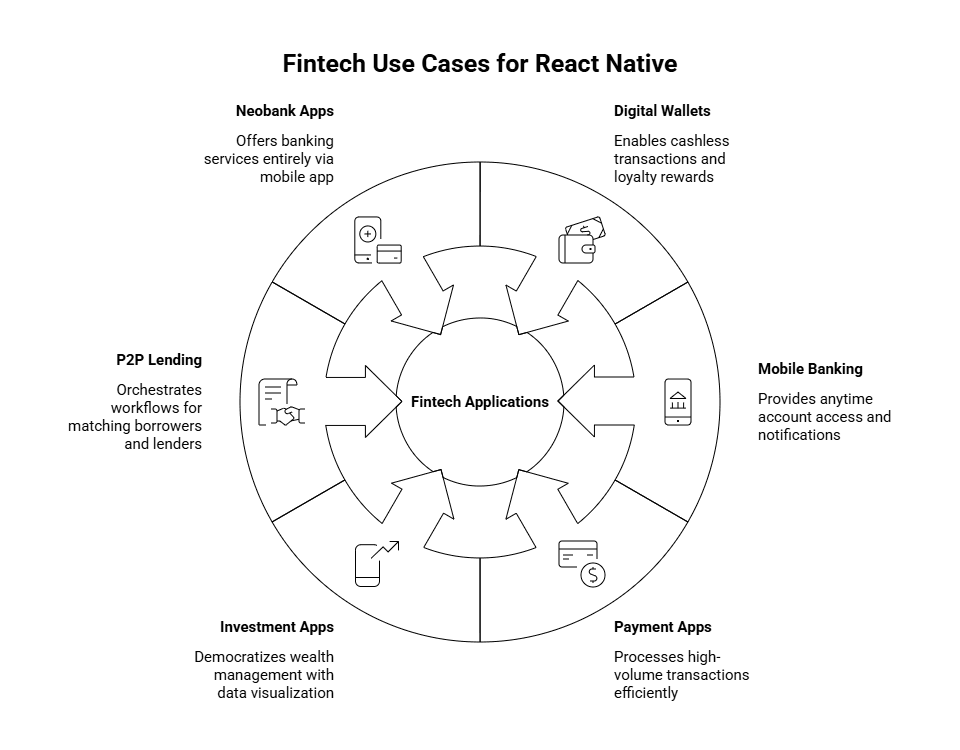 Image: React Native for Fintech
Digital Wallet & E-Wallet App Development
Digital wallets and e-wallets are core fintech solutions that enable seamless cashless transactions. Besides its hot-reloading capabilities that reduce development time while ensuring PCI DSS compliance, React Native enables digital wallets to:
- Maintain a single codebase for features like fund transfers, bill payments, and loyalty rewards.
- Be tailored with MyKad verification and EPF/SOCSO linkages for localized compliance.
- Support QR payments and balance tracking via intuitive real-time dashboards.
Mobile Banking App Development
Mobile banking apps provide anytime account access. They have reimagined traditional banking services into compliant digital experiences.
Beyond facilitating mobile bank app development by reusing code for secure, responsive UIs that synchronise with core banking systems, React Native also:
- Supports account access, P2P transfers, and real-time notifications for low-latency updates.
- Implements secure authentication flows using Face ID/Touch ID, JWT tokens, and behavioural biometrics to satisfy regulatory risk management standards.
- Delivers omnichannel experiences by linking apps with web portals and ATMs through consistent APIs and state management.
Payment App Development
Payment apps process high-volume transactions across multiple systems. As such, efficiency and accuracy matter at every step. In this regard, React Native's cross-platform efficiency enables:
- Robust payment gateway integrations without native rebuilds. Thereby, supporting seamless merchant adoption and frictionless processing when handling peak loads.
- Tokenization and secure API handling via HTTPS, PCI-compliant vaults, and ephemeral keys to protect card data.
- Ensures readiness for Malaysia's existing local payment ecosystem
Investment App Development
Investment apps democratize wealth management. In this same vein, React Native shines in visualizing complex data, enabling MVPs that scale to personalized portfolios. In fact, by exploiting React Native, investment Fintechs can:
- Build interactive portfolio dashboards with drill-down analytics on returns, diversification, and benchmarks.
- Execute real-time data visualization using WebSockets and charts for live market updates, ESG scores, and risk metrics.
- Streamline user education via guided onboarding flows and tutorials
Peer-to-Peer Lending App Development
React Native handles sensitive data securely. This is vital for credit scoring and dispute resolution. In peer-to-peer lending app development, it can be leveraged to:
- Orchestrate and accelerate workflows with modular components for matching borrowers and lenders efficiently.
- Manage borrower-lender lifecycle via dashboards for offers and repayments.
- Integrate risk assessment pipelines utilising ML models for credit scoring, approvals, and fraud detection.
Neobank App Development
A neobank is a digital-only fintech that offers banking services entirely via a mobile app or website—without physical branches. In the neobank sphere, React Native can help to:
- Enable lean launches with reusable modules for end-to-end digital journeys.
- Automate digital onboarding and KYC using MyKad OCR.
- Handles account lifecycle with automated freezes, upgrades, and churn prediction via user behaviour analytics.
Custom Fintech Mobile App Development with React Native
Most open-source Fintech solutions fail to address unique market demands and the regulatory nuances of Malaysia's dynamic digital finance landscape.
In fact, standard templates often overlook local payment integrations while lacking the agility to evolve with BNM's ever-changing digital asset rules. That being said, custom fintech mobile app development with React Native is mission-critical when:
- Tailoring Workflows for Malaysian Users: Some fintech products must adapt user journeys for Malaysian cultural preferences and multilingual support. Some workflows might need to account for internet connectivity gaps.
- Balancing UI Flexibility with Regulatory Constraints: Some products require modular UIs with customizable themes to enforce BNM-mandated modals for cooling-off periods, risk disclosures, and transaction limits. React Native allows this balance.
Also read: Is React Native Good for Enterprise Mobile Apps?
Fintech Compliance & Regulatory Considerations in Malaysia
When engineering Fintech apps, developers in Malaysia must account for rigorous compliance frameworks. For example, the Financial Services Act 2013, AMLA 2001, and PDPA 2010. Collectively, these frameworks prioritize customer protection, data privacy, and systemic stability amid rising cyber risks.
In fact, Malaysia offers a regulatory sandbox where new fintech ideas can be tested safely within limits. Furthermore, developers cannot ignore sector-specific rules like the Consumer Credit Act 2025 for BNPL apps and SC guidelines for digital assets. These rules ensure apps avoid penalties via annual audits and transparent reporting.
Overall, Bank Negara Malaysia (BNM) alignment dictates licensing for e-money, P2P lending, and digital banks. It also emphasizes risk management standards like the e-KYC Policy and Digital Currency frameworks.
Compliance-by-design integrates these requirements natively. For example, it enables Fintechs to embed AML flags in app logic, immutable audit trails via secure logging, and modular workflows for Shariah compliance.
Financial App Security Standards for React Native Apps
To ensure optimal security, React Native Fintech apps in Malaysia must adhere to PCI DSS 4.0, ISO 27001, and BNM cybersecurity guidelines. Collectively, these guidelines emphasize zero-trust architectures to protect sensitive data in high-stakes fintech environments.
For instance, some of these guidelines enforce secure authentication using biometrics and multi-factor authentication (MFA) with TOTP or push notifications. Thereby, ensuring layered defences against credential stuffing.
Some of these standards mandate device binding and behavioural biometrics to meet PDPA consent rules. Furthermore, some mandate data encryption with API security via JWT tokens, rate limiting, and secure storage using react-native-keychain for credentials.
When managing third-party libraries, fintech app security standards focus on minimizing supply-chain vulnerabilities and enforcing regular dependency updates. Thus, supporting scalable security for apps processing millions of daily payments.
React Native Architecture for Secure Fintech Apps
Secure fintech apps require a clear structure. A React Native architecture for secure fintech apps centers on a scalable, layered design. Such an architectural design ensures modularity that scales to millions of users.
Architectural design also affects audits. For context, shared logic handles business rules and cross-platform features while native modules handle platform-specific needs like device security. Security is embedded via zero-trust principles. For instance, input validation at every layer and containerization for micro-frontends. Thereby, aligning with PCI DSS and BNM standards for apps handling high-velocity transactions.
By the same token, React Native architectures support offline handling and data sync capabilities to handle variable or unstable connections. Relatedly, React native architectures feature monitoring capabilities like real-time crash reporting and immutable logging. Thereby, ensuring BNM sandbox readiness through exportable trails.
How to Choose a Fintech Mobile App Development Company in Malaysia?
Fintech projects carry inherent risk. As such, choosing the right partner affects success and mitigates a lot of the inherent risk. So, when vetting partners, always:
- Look for proven fintech domain experience first.
- Assess if the provider has solid regulatory knowledge.
- Evaluate if their security practices are clear. Ask about audits and testing.
- Investigate if they provide post-launch support.
Overall, React Native apps have been successful in a variety of market areas, such as:
- Powering product catalogues, easy checkout, and real-time updates for seamless shopping experiences in e-commerce apps.
- Social networking and community apps to deliver consistent performance across many devices.
- Internal business tools and dashboards to offer easy integration with backend systems and efficient data management.
Techies leveraged React Native in client projects such as Thryffy, a fashion marketplace app, and SPARQ, a coffee order and delivery app. Its React Native application ultimately sped time to market and reduced maintenance complexity through reusable code and API interaction.
Also read: React Native Mobile App Development Company: How to Choose the Best.
FAQs
Is React Native secure enough for fintech apps?
Yes, when implemented with best practices. It supports native-level security features like biometrics and encryption via bridges to iOS Keychain/Android Keystore.
Can React Native apps meet fintech compliance requirements in Malaysia?
Yes, React Native apps can fully meet Malaysia's fintech compliance. However, developers must embed compliance-by-design via modular components for KYC flows, audit logging with immutable records, and data localization.
How much does fintech app development cost in Malaysia?
Fintech app development in Malaysia typically ranges between RM150,000 and RM800,000 for a React Native MVP. However, these figures largely depend on the level of complexity.
Should fintech startups or enterprises use React Native?
Yes, both fintech startups and enterprises should employ React Native for its balance of speed, cost, and scalability. Startups gain an edge in agility while enterprises gain in maintenance efficiency.
What is Fintech App Development Cost in Malaysia?
Fintech app development costs in Malaysia are primarily driven by scope differences. For instance, MVPs prioritize core features like authentication and payments, while enterprise solutions focus on scalability, AI analytics, and multi-region support. These distinctions often inflate timelines and cost.
Final Verdict: Is React Native Suitable for Fintech App Development in Malaysia?
In conclusion, React Native offers founders, CTOs, and product owners a compelling blend of cross-platform efficiency and native performance. These factors align with the Malaysian market's rapid digital finance growth.
In fact, its ability to reuse 90% of codebases accelerates MVPs for e-wallets or neobanks. Security is bolstered through native modules for biometrics, AES-256 encryption, and PCI DSS adherence. For scalability, React Native supports high traffic demands via Redux state management and cloud syncing.
So, ready to build your fintech app? Techies offers expert web app development and mobile app development services perfectly tailored for Malaysia's fintech landscape.

Digitizing businesses since 2017


© 2026 Techies | All rights reserved