
React Native Mobile App Development Company: How to Choose the Best
 By Kok Weng•Published at 22 Dec, 2025•Updated 21 Oct, 2026
Key Takeaways:
- React Native lets businesses build high-performance iOS & Android apps using one shared codebase.
- Companies choose React Native to cut development costs, shorten launch timelines, and maintain consistent user experiences.
- The framework delivers near-native performance by rendering real native UI components—unlike hybrid web-based solutions.
- Ideal for MVPs, startups, multi-platform apps, and products requiring frequent updates.
- A React Native development company handles end-to-end delivery—from UI/UX and coding to API integration, testing, and app store publishing.
- Strong ecosystem support, hot reload, and efficient API integrations accelerate development and long-term scalability.
Introduction: Why Businesses Are Turning to React Native for App Development
Today’s businesses want fast, high-performing mobile apps without doubling cost or build time. Most also want their users on iOS and Android to have the same experience in terms of ease and performance.
Building two separate apps often slows delivery and raises budgets. Long rebuild cycles delay launches and increase maintenance overhead.
However, cross-platform mobile app development offers a practical answer to these problems. One shared build works across major mobile operating systems with powerful performance.
React Native has become the preferred cross-platform mobile app development framework for many teams worldwide. In practice, it lets developers craft native-feeling apps from one unified codebase.
A React Native mobile app development company helps guide this process. They handle design, coding, setup, testing, and app store launch. Consequently, the payoff is clear—faster business product delivery, lower cost, and steady quality across devices.
What Is React Native Mobile App Development?
React Native mobile app development leverages the React Native open-source framework created by Meta (Facebook). This framework enables developers to build mobile apps with JavaScript and TypeScript. Fundamentally, it relies on a single code base to produce apps for both iOS and Android—promoting efficiency and consistency across platforms.
In practice, the framework compiles JavaScript and TypeScript code into native UI components. Afterwards, it renders them as actual platform-specific views like UIView on iOS or Android View on Android. Consequently, this mechanism delivers performance that matches fully native apps by avoiding web wrappers for smoother interactions.
How Does React Native Work Behind the Scenes?
At the core of React Native's design is a bridge that allows asynchronous communication via serialised JSON data across different threads. It achieves this by connecting JavaScript code—which is written in languages like JavaScript and TypeScript—to native platform APIs.
While a shadow thread computes layouts and transmits instructions across the bridge to the native UI thread, the JavaScript thread manages business logic. Consequently, this direct rendering guarantees fluid, high-performance interactions.
In practice, this setup allows for the flexible integration of device features like camera, GPS, and push notifications via native modules accessed via the bridge. Thus, maintaining native-like responsiveness with one codebase whilst supporting scalability.
As such, by compiling to true native UI components, React Native avoids performance bottlenecks of hybrid apps. This consequently enables it to deliver fluid interactions comparable to fully native development.
What Makes React Native Different from Other Frameworks?
React Native leverages a single JavaScript or TypeScript codebase to construct apps for both platforms. This characteristic sets it apart from traditional native app development with Swift (iOS) and Kotlin (Android).
Because developers don't have to write and maintain separate code for iOS and Android, this cross-platform strategy drastically cuts down on development time and expense.
Furthermore, though native development offers superior performance and deeper hardware integration, React Native’s modern architecture delivers near-native performance by compiling to actual native UI components. This same characteristic distinguishes it from hybrid frameworks that usually lack the responsiveness and natural experience.
Overall, React Native is favoured for the majority of commercial applications because of its efficiency and versatility—striking a balance between cross-platform ease and native-like performance. However, traditional native development is still the best option for highly specialised or resource-intensive programs.
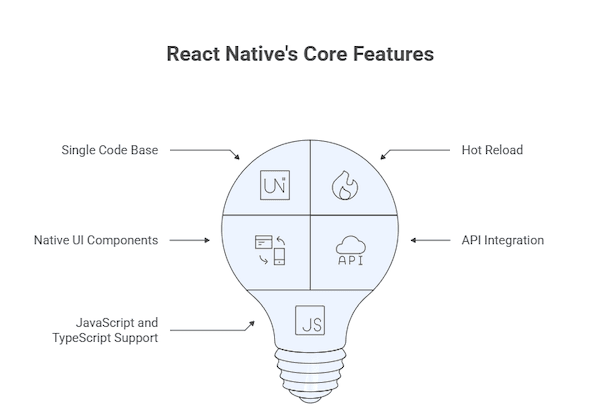 Reach Native is defined by five main key features, namely:
- Single code base across platforms that streamlines development, cuts costs, and simplifies maintenance across targets.
- Hot reload that delivers instant code updates by reflecting changes in real-time without full app restarts,
- Access to native UI components that ensure smooth, high-performance experiences.
- Strong API integration capabilities to connect seamlessly to services like payment gateways or CRM tools via native modules and bridges
- Support for JavaScript and TypeScript that provides a developer-friendly setup with familiar syntax, type safety, and declarative components. This consequently enables efficient, scalable coding.
What Are the Advantages of React Native for Businesses?
React Native delivers several advantages to businesses, such as:
- Faster time to market through cross-platform development, which reduces release cycles by up to 50%.
- Cost efficiency from shared code reuse—slashing development and maintenance expenses compared to separate native builds.
- Consistent user experiences across devices due to native UI rendering.
- Access to a large community and ecosystem offers thousands of libraries and plugins for rapid feature additions.
- Easier API integration connects backends like CRMs or payments via native modules.
Companies like Techies leverage these strengths in cross-platform development to accelerate delivery, integrate APIs swiftly, and appreciably cut maintenance costs.
When Should a Business Choose React Native?
Businesses should choose React Native when:
- Building MVPs or for startups needing quick launches. This is because its cross-platform capabilities cut development time by up to 50% for rapid iteration.
- Targeting both iOS and Android with consistent branding, sharing 85-95% code to maintain uniform design and functionality across platforms.
- Future updates or feature additions will be frequent. In practice, its hot reload capabilities and a vast ecosystem simplify ongoing maintenance. However, intricate, hardware-heavy apps—like those with intensive AR/VR or specialized sensors—might still benefit from full native development for optimal performance.
Also read: [React Native Development Trends: Why You Should Consider Developing with React Native](When Should a Business Choose React Native? Businesses should choose React Native when: Building MVPs or for startups needing quick launches. This is because its cross-platform capabilities cut development time by up to 50% for rapid iteration. Targeting both iOS and Android with consistent branding, sharing 85-95% code to maintain uniform design and functionality across platforms. Future updates or feature additions will be frequent. In practice, its hot reload capabilities and a vast ecosystem simplify ongoing maintenance. However, intricate, hardware-heavy apps—like those with intensive AR/VR or specialized sensors—might still benefit from full native development for optimal performance. Also read: React Native Development Trends: Why You Should Consider Developing with React Native. ).
Real-World Use Cases of React Native Apps
React Native apps thrive in many market niches, for instance:
- E-commerce apps rely on React to power product catalogues, seamless checkout, and real-time updates to create smooth shopping experiences.
- Social networking and community apps leverage React Native to provide interactive user profiles and content feeds that deliver consistent performance across disparate devices.
- Food delivery and logistics apps exploit React Native’s fast updates and native-like responsiveness for order tracking and push notifications.
- Internal business tools and dashboards built with React Native’s shared codebases enable easy integration with backend systems and efficient data management.
Techies have applied React Native’s cross-platform principles in client projects like SPARQ, a coffee order and delivery app, and Thryffy, a fashion marketplace app. This application consequently accelerated time to market and reduced maintenance complexity through reusable code and API integration.
What Does a React Native Mobile App Development Company Actually Do?
A React Native mobile app development company like Techies manages the end-to-end process that entails:
- Planning, UI/UX design, coding, and testing.
- Ensuring smooth API integrations with existing systems.
- Deploying and maintaining apps across iOS and Android. In practice, the work begins with business planning and roadmap definition. Design teams develop UI layouts fit for mobile screens and conduct UX testing checks on ease of use and clarity.
Developers then code using JavaScript and TypeScript frameworks. API integrations link the app with backend systems. Payment gateways, user accounts, and content systems flow directly into the interface.
Quality testing runs on physical devices and simulators. Afterwards, development teams fix layout issues across phone sizes. After testing, apps are published to the Apple App Store and the Google Play Store. In most instances, the teams handle compliance steps and review submissions, as well as post-launch support handles updates, bug fixes, and feature expansions.
How to Choose the Right React Native Development Partner?
Selecting the right development partner shapes long-term mobile success. When identifying the right React Native development partner:
- Start by reviewing their cross-platform mobile app development portfolio. Look for real, shipped apps across industries.
- Confirm proven experience with complex API integrations. You can ask about payment systems, live notifications, and secure user accounts.
- Assess post-launch support offerings. Great teams stay involved beyond launch day.
- Check familiarity with Apple and Google publishing requirements.
- Look at community engagement. Contributors to the React Native ecosystem remain updated on best practices.
Techies, for example, combine deep technical experience with agile project delivery for scalable, future-proof solutions. Our team of experienced full-stack engineers and creative UI/UX designers works closely together to turn concepts into powerful digital goods. Thus, guaranteeing dependable, high-calibre mobile apps.
_Also read: Mobile App Development Outsourcing in Malaysia (Guide and Tips) _
Looking for a React Native team in Malaysia? Our list of the top 10 mobile app development companies in Malaysia shows each company's tech stack, so you can see who works with React Native.
Conclusion: Building the Future of Cross-Platform Apps
React Native strengthens how businesses approach mobile development today. It enables speed without heavy cost increases. Furthermore, it ensures native-like performance without full platform duplication.
Cross-platform builds now deliver enterprise-grade quality at startup-level budgets. Yet success still depends on the development partner behind the framework.
A skilled React Native mobile app development company turns vision into working releases. They guide architecture, maintain code health, and protect long-term stability. Businesses gain faster launches. Teams manage costs better. Users enjoy reliable mobile experiences across every device.
Whether you’re building your first app or optimising an existing one, a React Native mobile app development company in Malaysia like Techies can help you create once, deploy everywhere, and grow faster.”
At Techies, we oversee the full development lifecycle, from planning and UI/UX design to coding, testing, deployment, and maintenance—with proficiency in React Native, JavaScript, and TypeScript. We also provide seamless API connections with existing systems.
About Author
Kok Weng
Kok Weng Kong is a tech enthusiast and problem-solving expert with a passion for technology and innovation. As the Founder & CEO of Techies App Technologies Sdn. Bhd., he specializes in building beautiful web and mobile applications and providing branding and marketing solutions for businesses. With a background in Information Technology and extensive experience in the industry, Kok Weng Kong excels in creating innovative solutions for various tech challenges.


Digitizing businesses since 2017


© 2026 Techies | All rights reserved