
Flutter vs React Native: Which Is better For App Development 2026
 By Kok Weng•Published at 19 Feb, 2026
Cross-platform app development still dominates product strategy in 2026. Realistically, startup and enterprise teams nowadays want faster releases, fewer engineers, and predictable maintenance across platforms.
In fact, most mobile apps currently focus speed, design, and data handling, not framework popularity alone. As such, the real questions businesses should ask revolve around time-to-market, long-term technical scalability needs, and AI readiness.
Statista predicts that the global cross-platform app market may reach $547 billion by 2026. Presently, Flutter and React Native lead cross-platform adoption throughout finance, retail, and logistics sectors.
Flutter leads in cross-platform market share with about 46% against React Native, which is around 35%. Generally, both frameworks matured since their early versions, as each now solves different problems better than before.
However, choosing between them dictates clear trade-offs, not brand loyalty or developer comfort alone. Let’s dig deeper, shall we?
What Is Flutter?
Flutter is Google’s UI toolkit for building natively compiled applications across disparate platforms using a single codebase. In practice, Flutter employs a custom engine to render the user interface (UI) directly onto the canvas without depending on platform-specific components.
Its architecture also exploits the Dart programming language to deliver fast performance and hot reload for quick iteration. Thereby, ensuring pixel-perfect UI consistency across platforms whilst guaranteeing identical visuals and fluid 60fps animations.
What Is React Native?
React Native is Meta’s framework for engineering mobile apps primarily using JavaScript, with additional support for TypeScript.
In practice, it bridges JavaScript code with native platform components. Thereby, allowing developers to create high-performance iOS and Android apps from a shared codebase. All while leveraging the familiar React ecosystem for declarative UI development.
Under the hood, React Native renders true native UI components rather than web views. For example, UIKit on iOS and Android Views. This mechanism consequently ensures apps feel and perform indistinguishably from fully native ones.
Furthermore, its deep integration with the JavaScript ecosystem appreciably accelerates development. This consequently makes it popular amongst teams already using React.
React Native vs Flutter Comparison: Core Differences at a Glance (2026)
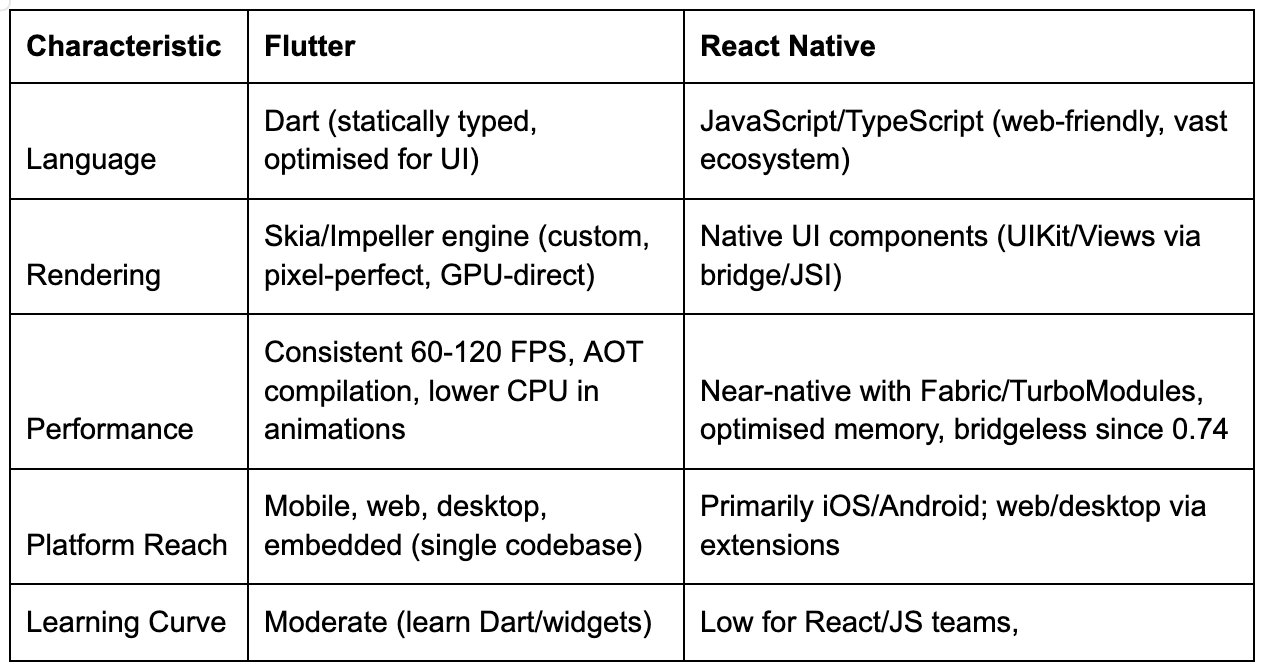
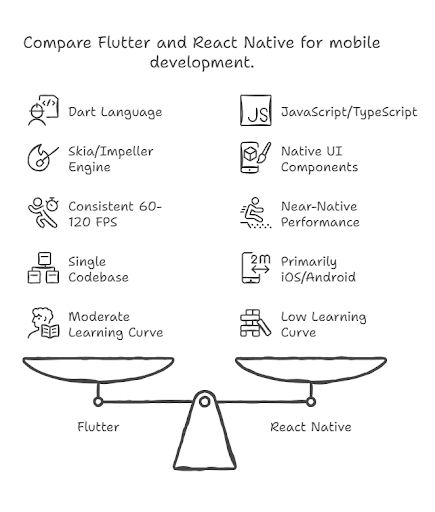 React Native and Flutter differ fundamentally in language, rendering, and platform reach. Let’s illustrate the distinctions in a table.
Flutter vs React Native Performance Comparison: Which Is Faster in 2026?
Flutter edges out in startup time. For context, its AOT compilation yields 20-40% faster cold starts. Furthermore, runtime performance favors Flutter's Impeller engine for consistent 60-120 FPS under load.
Relatedly, animation smoothness shines in Flutter due to its GPU-driven Skia rendering. However, React Native's Fabric architecture closes gaps in real-world apps like e-commerce scrolls or games.
Overall, real-world performance prioritises sustained metrics over benchmarks. Flutter delivers fewer crash rates and battery savings, while React Native excels in Facebook-scale feeds via native optimisations.
UI & UX Capabilities: Design Freedom vs Native Feel
Flutter offers unmatched custom UI control through widgets and Skia. Thus, enabling pixel-perfect designs identical across platforms without OS widget dependencies. In contrast, React Native delivers an authentic native feel by mapping to UIKit/Views.
Furthermore, complex animations tend to favor Flutter's declarative model for hero transitions and physics. By the same token, React Native's Reanimated 3 handles them via native threads but risks inconsistency.
Generally, while React Native respects standards like iOS swipe motions, increasing familiarity, Flutter thrives on consistency for cross-device uniformity.
Also read: Importance of UI/UX Design in Enhancing Mobile & Web App Functionality
Ecosystem, Libraries & Community Support (2026 Update)
Flutter hosts 40k+ mature plugins with Google-backed stability. It excels in UI kits but lags in niche native bridges compared to React Native's 1.8M npm packages.
Furthermore, React Native boasts a larger community and enterprise adoption (Meta, Shopify). This consequently ensures faster patches. Additionally, dependency risks are lower in Flutter's isolated Dart ecosystem, while React Native's JS sprawl demands vigilant updates. However, both usually follow 3-6 month update cycles
Web, Desktop & Beyond: Multi-Platform Reach
Flutter is superior with native-tier web/desktop compatibility using CanvasKit/WASM. This characteristic allows macOS/Windows tools and PWA-like apps to reuse 90% of their code without sacrificing functionality.
React Native focuses on mobile excellence. However, it extends via React Native Web (strong for PWAs) and experimental desktop. Generally, future-proofing favours React Native for web-mobile hybrids utilising the React ecosystem, whereas Flutter is better for AR, VR, and embedded systems.
AI, Integrations & Modern App Requirements: Flutter vs React Native
Both frameworks integrate seamlessly with AI SDKs like TensorFlow Lite or ML Kit. However, Flutter's Dart FFI accelerates on-device inference. This makes it suitable for real-time personalisation in e-commerce.
In contrast, React Native shines best when handling real-time data streams and analytics with Firebase/WebSocket ease. Furthermore, backend/cloud ties (AWS Amplify, Supabase) and third parties tend to favour React Native's npm breadth.
Cost Implications, Time-to-Market & Business Impact
Flutter accelerates time-to-market. This is mainly thanks to 13% faster cycles (304 vs 343 hours for MVPs) and hot reload under 1s. As such, it’s ideal for startups iterating UIs.
Furthermore, long-term maintenance costs drop 20-30% in Flutter. This is mainly because of its uniform codebases versus React Native's native module upkeep.
Additionally, hiring availability typically favours React Native. However, Flutter developers have a rising demand. Lastly, ROI tilts towards Flutter for design-heavy apps while React Native tends to be better suited for web-synced teams.
Also read: Flutter App Development Cost: A Detailed Breakdown (2023).
When Flutter Is the Better Choice?
React Native is a better choice in 2026 for:
- Teams with strong React/JavaScript expertise: React Native builds directly on React syntax and hooks. Thereby, enabling JS/TS teams to reuse 70-90% of web skills for instant productivity without learning Dart.
- Apps needing a more native platform feel: By rendering true native components, it provides authentic gestures, haptics, and accessibility that feel indistinguishable from Swift/Kotlin apps.
- Faster onboarding with existing web teams: It accelerates prototyping, sharing logic between web/mobile via React Native Web for unified pipelines and CI/CD.
- Apps that are heavily reliant on native platform APIs: It surpasses Flutter in maturity for fintech, social, or hardware-tied apps. This is because its bridgeless New Architecture offers direct access to iOS 19 SwiftUI or Android 16 Jetpack APIs.
Generally, React Native apps are successful in multiple market sectors. For example:
- e-commerce apps to power product catalogues, easy checkout, and real-time updates, delivering fluid shopping experiences.
- Social networking and community apps to deliver uniform performance across many devices via interactive user profiles and content feeds.
- Food delivery apps for order tracking and push alerts, exploiting its quick updates and native-like responsiveness.
Techies deployed the cross-platform principles of React Native in client projects such as the fashion marketplace app Thryffy. We have also deployed Reach Native within the coffee order and delivery service SPARQ. The results of both deployments shortened the time to market and decreased maintenance complexity. This was largely thanks to reusable code and API integration.
Also read: React Native Mobile App Development Company: How to Choose the Best and React Native Development Trends: Why You Should Consider Developing with React Native.
Flutter vs React Native: Which Should You Choose in 2026?
Choosing between Flutter and React Native in 2026 largely hinges on aligning framework strengths with specific project needs. As you do this, create a decision framework that start with product goals.
In this stage, evaluate if your app prioritises pixel-perfect custom UIs and consistent performance across platforms. Next, review team skills. React Native teams gain immediate velocity with React Native's npm ecosystem. Teams open to Dart thrive with Flutter's structured widgets and sub-1s hot reload.
Afterwards, consider the platform strategy early. For instance, multi-platform ambitions (mobile, web, and desktop) tend to favour Flutter's 90% code reuse across all targets.
Lastly, think about the long-term scale. For instance, React Native's vast community (500k+ devs) and enterprise backing ensure plugin maturity and easier scaling.
FAQs
Is Flutter faster than React Native in 2026?
Flutter generally outperforms React Native in 2026 for rendering and animations. This is largely thanks to its Impeller engine.
Is React Native still relevant in 2026?
Yes, React Native remains highly relevant in 2026. In fact, it dominates mobile-focused enterprises needing native APIs, holding 35% cross-platform share.
Which is better for startups- Flutter or React Native?
React Native suits most startups desiring rapid MVPs via Expo and web reuse. Flutter wins for custom UI startups targeting multi-platform MVPs since it offers 30-40% faster iterations via hot reload.
Which framework scales better for enterprise apps?
Both scale to millions of users. However, React Native edges enterprise with mature native modules, a larger talent pool, and backend integrations.
Flutter vs React Native for long-term maintenance?
Flutter offers lower maintenance via unified Dart codebases and fewer platform tweaks. React Native demands more native upkeep. However, it benefits from vast community fixes and JS familiarity for large teams
Flutter vs React Native development speed: which one is faster?
With 30–40% faster cycles and sub-1s hot reload for custom designs, Flutter speeds up UI development. For JS teams prototyping content apps, React Native offers a 20% faster onboarding process by utilising npm.
Final Verdict: Flutter or React Native?
Overall, neither Flutter nor React Native is universally "better". Rather, superiority depends on one’s particular situation rather than existing trends or benchmark battles.
For projects requiring visual innovation, wide platform support, and uncompromising performance from a single codebase, Flutter is ideal in 2026. In contrast, React Native excels for JavaScript-focused teams and apps that prioritise native fidelity and ecosystem leverage.
Ready to build your next React Native and Flutter app? Kindly explore Techies' web app development and mobile app development services for expert React Native and Flutter guidance and delivery.
About Author
Kok Weng
Kok Weng Kong is a tech enthusiast and problem-solving expert with a passion for technology and innovation. As the Founder & CEO of Techies App Technologies Sdn. Bhd., he specializes in building beautiful web and mobile applications and providing branding and marketing solutions for businesses. With a background in Information Technology and extensive experience in the industry, Kok Weng Kong excels in creating innovative solutions for various tech challenges.


Digitizing businesses since 2017


© 2026 Techies | All rights reserved