
Choosing A Flutter Mobile App Development Company
 By Kok Weng•Published at 19 Feb, 2026
Flutter is fast gaining acclaim in the enterprise and startup space. And with good reason! This is mainly thanks to its reactive architecture, single codebase framework, and Hot Reload for rapid iterations.
In fact, Google's open-source UI toolkit for constructing natively compiled, high-performance apps cuts development time by 30-50%. Thereby, enabling faster market validation and entry.
Proof of its increasing renown is the fact that 46% of developers currently leverage the cross-platform framework. For context, that’s more than 2 million active developers worldwide. Some of these developers work for titans like Amazon, BMW, and eBay. To paint a better picture, as of 2026, over 500,000 apps published on the PlayStore were powered by the Flutter framework. This speaks volumes as its consistent UIs appeal to startups needing quick MVPs and enterprises handling complex apps.
However, companies choosing the wrong Flutter development partner face several inherent risks. For instance, poor architecture, scope underestimation, unreliable delivery, and failure to handle compliance.
What Is Flutter App Development?
Flutter is essentially Google's open-source UI software development kit (SDK) for constructing natively compiled high-performance cross-platform apps from a single codebase.
In practice, it leverages the Dart programming language and a reactive framework to deliver rich, customisable interfaces—underpinned by near-native performance.
Relatedly, Flutter app development revolves around using Flutter's single codebase approach to enable deployment to iOS, Android, web, and desktop—without rewriting code. Flutter app development typically cuts development time by up to 50% and simplifies maintenance.
Generally, Flutter stands out strategically for its scalability when expanding to new platforms. It also features a robust ecosystem with production-ready plugins. Additionally, it offers future-proofing through Google's backing. Collectively, these characteristics make it ideal for startups iterating on MVPs and enterprises building long-term, multi-experience apps.
When Does It Make Sense to Hire a Flutter Development Company?
Hiring a Flutter development company makes sense when certain business needs align with Flutter's capabilities in speed, scalability, and cross-platform efficiency. This is especially true for organisations with limited resources and internal knowledge. Let’s give some context, shall we?
- Startups building MVPs quickly: Flutter's Hot Reload and single codebase enable 30-50% faster development cycles. This consequently enables startups to launch polished prototypes in weeks rather than months. In turn, they can validate and iterate cost-effectively based on user feedback—without separate iOS/Android teams.
- Businesses launching apps across iOS, Android, web, or desktop: Consistent UI/UX and simultaneous deployment are guaranteed by a single codebase. This can save maintenance costs by up to 40% and easily reach larger audiences.
- Companies modernising legacy mobile apps: Flutter makes it easier to migrate from out-of-date native apps. Thereby, enhancing performance and providing multi-platform support with less restructuring. This also often lowers long-term maintenance costs.
- Products with strong UI/UX and performance requirements: Skia rendering and custom widgets produce pixel-perfect designs at native 60 FPS speeds. This makes Flutter ideal for immersive finance or commerce apps that require high fidelity and responsiveness.
How To Find a Flutter App Dev Partner: Key Criteria to Evaluate
Flutter is not just a cost choice. It seamlessly supports faster testing, updates, and feature growth. However, choosing a partner takes more than a sales pitch. In practice, Flutter development work demands real hands-on skills in its unique widget tree, reactive architecture, and Skia rendering.
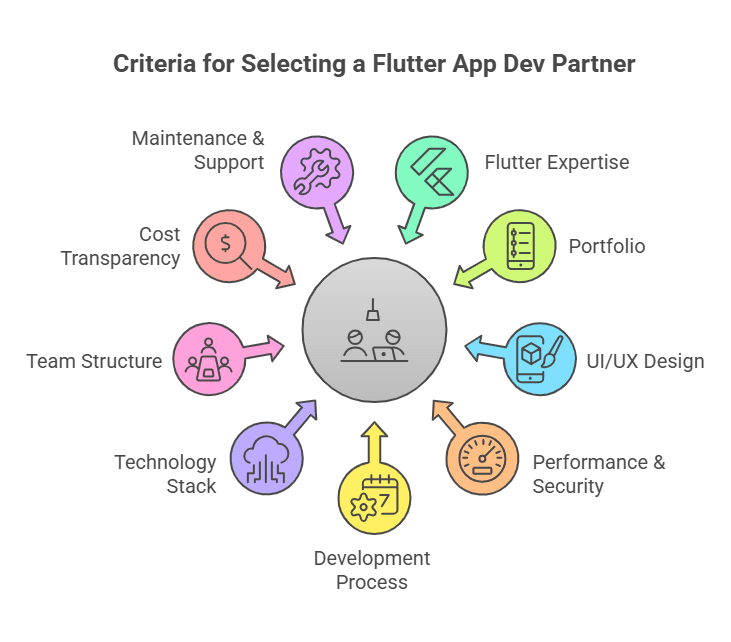 Image: How to choose a flutter mobile app development company
As such, below are key areas to rigorously assess before signing with any Flutter app dev partner.
1. Proven Flutter Expertise
Years of dedicated Flutter experience matter exponentially more than generic claims. As such, always seek competent teams with 3+ years of building proven production apps. They should not just be recent experiments or side projects.
Furthermore, their proficiency in Dart should go beyond syntax. It should include advanced state management, clean architecture patterns, and optimisation for memory leaks.
In fact, any prospective developer should also possess a deep understanding of Flutter's rendering engine and widget system. This will help avoid performance pitfalls like excessive rebuilds in complex UIs.
2. Portfolio & Real-World Flutter Apps
Instead of mockups or internal demos, demand links to live apps on the App Store and Play Store. This will help you assess downloads, ratings, and retention analytics.
Ensure to also request case studies that highlight features like offline support, real-time data sync, or bespoke animations.
Additionally, give special priority to industry-aligned portfolios that demonstrate scalability. For example, FinTech apps that can handle more than 100,000 users.
3. UI/UX & Design Capability
Design skill matters as much as code. As such, the best dev partner candidates always excel at engineering custom, scalable Flutter UIs. They are proficient in using responsive widgets and adaptive layouts for foldables or varying screen sizes.
Typically, their experience spans Material Design 3, Cupertino for iOS fidelity, and custom design systems. They also thrive in collaboration that involves designers and devs engaging symbiotically to ensure pixel-perfect fidelity and accessibility compliance.
Also read: Importance of UI/UX Design in Enhancing Mobile & Web App Functionality.
4. Performance, Security & Code Quality
Performance tuning isn’t optional since large Flutter apps need intentional care. As such, assess if prospective partners utilise the latest app performance optimisation strategies. For example, profiling with DevTools for 60 FPS rendering, lazy loading, and image caching It’s also imperative to evaluate if their security covers secure API handling, OAuth/JWT auth, data encryption, and compliance like GDPR. Additionally, investigate if they enforce clean architectures, perform unit tests at 80%+ coverage, and maintain comprehensive docs for maintainability.
5. Flutter Development Process & Delivery Model
Solid projects always start with discovery and requirement validation. So, assess if any prospective partner supports discovery workshops to validate
These workshops should lay the foundation for architecture design and development of interactive UI mocks. Potential partners should also define sprint cycles. For example, Agile sprints (2-week cycles) with daily standups to ensure transparency. Their post-launch support should also include SLAs for hotfixes and feature roadmaps.
6. Technology Stack & Integration Expertise
Prospective developer partners must possess expertise that spans backend, API, and cloud integrations like Node.js, Firebase, or Supabase.
Furthermore, they should possess proven competence with third-party SDKs, Stripe payments, Firebase Analytics, Amplitude, and AI tools like Gemini. Additionally, assess if they can orchestrate CI/CD pipelines via GitHub Actions and handle release automation.
7. Team Structure & Communication
To prevent context-switching delays, choose agencies with dedicated teams (3–7 members: PM, developers, QA, and designers) over shared teams. Furthermore, investigate if prospective agencies utilise Slack or Microsoft Teams for daily updates or Jira for project management.
Remember that communication cadence and reporting transparency cannot be taken lightly. Furthermore, ensure to request trial tasks to ensure cultural and collaboration fit, as well as to test time-zone overlap.
8. Cost, Pricing Models & Commercial Transparency
Pricing models vary by scope. Time-and-materials suits iterative Flutter projects, while fixed-price fits well-scoped MVPs. As such, it’s imperative to understand cost drivers like app complexity, integrations, and team seniority.
When investigating prospects’ cost and pricing models, look out for red flags like vague scopes and no breakdowns. Generally, always focus on value. The cheapest bids often cost more later. Value beats low price.
Also read: Flutter App Development Cost: A Detailed Breakdown (2023).
9. Maintenance, Support & Long-Term Scalability
As an open-source framework, Flutter updates often. As such, apps must keep pace. That being said, prospective partners should guarantee 6-12 months of free support. This support should include the handling of Flutter version upgrades and dependency updates.
They should also offer proactive bug fixing via Sentry monitoring and performance audits to ensure reliability. Additionally, the support should be flexible, scaling via modular code, and knowledge transfer through code reviews and handover docs.
Common Mistakes to Avoid When Choosing a Flutter Partner
Choosing a Flutter development partner requires avoiding pitfalls that lead to subpar apps, delays, and escalating costs. This is because many teams overpromise on Flutter's single-codebase promise without the depth to deliver scalable results. So, here are some mistakes to avoid:
- Choosing based on cost alone: Low bids often signal a possibility of technical debt, frequent bugs, and higher long-term rework expenses. So, prioritise value through proven ROI case studies instead.
- Falling for generic “cross-platform experts”: Experience in React Native or Xamarin doesn't equate to Flutter mastery. So, always request code audits to expose gaps.
- Ignoring post-launch support capability: Launch is just 20% of the journey. So, vet maintenance packages and retention metrics from past clients.
- Not validating Flutter-specific experience: Sales demos hide weaknesses. So, always insist on live app links, GitHub repos, or trial tasks to confirm hands-on Flutter proficiency.
FAQs
How much does it cost to hire a Flutter app development company?
Costs vary by scope and region. In practice, simple apps cost less. Complex UI and backend raise the price. Furthermore, in most cases, ongoing support adds cost.
Is Flutter suitable for enterprise-grade apps?
Yes, many firms utilise Flutter at scale. This is primarily due to its native performance, scalability via modular architecture, and secure integrations like OAuth and Firebase.
How long does Flutter app development take?
Timelines span 2–3 months for MVPs, 3–6 months for mid-tier apps with APIs/notifications, and 6–12+ months for enterprise builds.
Should I choose a local or offshore Flutter development company?
Offshore partners may sometimes be cheaper but tend to require strong project management to manage communication gaps. However, local teams excel in regulated industries needing face-to-face collaboration and cultural alignment.
Which is faster: Flutter or React Native?
Flutter outperforms React Native in development speed and runtime. Furthermore, while React Native bridges legacy ecosystems, Flutter is superior for UI-heavy, multi-platform launches.
Read: Flutter vs React Native: Which Is better For App Development 2026
Concluding Remarks and Final Checklist: Choosing the Right Flutter App Development Company
Flutter adoption will continue to surge across startups and enterprises in 2026. This surge will be driven by its rapid development speed and single codebase efficiency that doesn’t compromise performance.
As such, prospective Flutter app development partners must demonstrate more than promises. They must demonstrate technical capability, delivery reliability, business alignment, and long-term partnership potential. The wrong development partner risks poor code quality, sluggish apps, and expensive rewrites.
Ready to build your next Flutter app? Partner with Techies for expert web app development and mobile app development services tailored to startups and enterprises. Contact us to kickstart your project with proven Flutter excellence.
About Author
Kok Weng
Kok Weng Kong is a tech enthusiast and problem-solving expert with a passion for technology and innovation. As the Founder & CEO of Techies App Technologies Sdn. Bhd., he specializes in building beautiful web and mobile applications and providing branding and marketing solutions for businesses. With a background in Information Technology and extensive experience in the industry, Kok Weng Kong excels in creating innovative solutions for various tech challenges.


Digitizing businesses since 2017


© 2026 Techies | All rights reserved