
Front-End vs Back-End Developer: What Is The Difference?
 By Kok Weng•Published at 29 Jul, 2025
Summary
Front-end and back-end developers play distinct yet complementary roles in web development.
Front-end development focuses on user interfaces and experience, utilising technologies like HTML, CSS, and JavaScript to create visually appealing and interactive designs. In contrast, back-end development manages server-side logic, databases, and APIs, ensuring smooth data processing and security using languages like Python, PHP, and Node.js.
Full-stack developers bridge both fields, offering versatility in development. Demand for developers is rising, driven by digital transformation, especially in Malaysia. Businesses seeking robust applications should leverage expert developers to optimise both user experience and system functionality.
Introduction
Developers are the bedrock of web development. They execute a range of tasks related to building and managing software applications and websites.
In fact, they need to be skilled in various programming languages to guarantee that software products satisfy both practical and aesthetic standards. They work closely with UI designers to ensure that every website element complies with the client's vision, budget, and schedule.
Despite both contributing to a seamless user experience, front-end and back-end developers are often confused or used interchangeably. Understanding the distinctions between both roles is imperative because each requires a unique skill set.
This article seeks to explore the differences between these roles and how they complement each other to deliver seamless user experiences.
What is front-end development?
Front-end development is the process of iteratively developing the interactive and visual elements of a web application that users directly interact with.
Sometimes referred to as client-side development, front-end development principally encompasses user interface functionality engineering as well as layout and design.
Front-end developers often employ essential technologies like:
- HTML (HyperText Markup Language) for content organisation
- CSS (Cascading Style Sheets) for layout and styling
- JavaScript for incorporating dynamic elements and interactivity Additionally, they conventionally leverage frameworks and libraries like React, Angular, and Vue.js to streamline development processes through effective state management and reusable components.
Generally, the key responsibilities of a front-end developer include:
- Building user interfaces: Translating design mockups into functional code.
- Performance optimisation: Enhancing website speed by optimising resources.
- Ensuring cross-browser compatibility: Iteratively testing and optimising websites for different browsers and devices.
- Responsive design: Creating layouts that adapt seamlessly to various dynamic screen sizes.
- Usability testing: Identifying and fixing usability issues to improve user experience.
- Collaboration: Working closely with back-end developers and designers to ensure cohesive functionality. Overall, the importance of UI/UX in front-end development cannot be overstated. A thoughtfully designed interface not only attracts users but also facilitates intuitive navigation. Thus, making it easier for them to accomplish tasks.
So, by prioritising user experience, front-end developers help ensure that websites aren't only visually appealing but also functional, accessible, and engaging. Thereby, ultimately driving user satisfaction and retention.
##What is back-end development? Back-end development refers to the iterative engineering of server-side components of a web application. This includes business logic, database interactions, and server configurations.
In practice, backend development revolves around the handling and processing of data, ensuring that the front end runs smoothly and effectively.
Backend developers employ a variety of server-side programming languages, including Node.js, Python, PHP, Ruby, and Java. They also use databases like PostgreSQL, MongoDB, and MySQL to store and retrieve data as needed.
Back-end development also relies heavily on Application Programming Interfaces (APIs). These allow data exchange and functionality requests between the front end and the back end.
Key responsibilities of a back-end developer include:
- Server management: Programmatically configuring and maintaining servers to ensure optimal performance.
- Data processing: Instituting algorithms and business logic to process data efficiently.
- Database management: Iteratively designing and managing databases to store application data securely.
- API development: Engineering APIs that allow front-end applications to communicate with back-end services.
- Data processing: Implementing algorithms and business logic to process data efficiently.
- Security implementation: Ensuring that applications are secure from vulnerabilities and unauthorised access.
- Performance optimisation: Iteratively monitoring and optimising application performance for speed and reliability. Because it manages critical back-end processes that give apps their utility, back-end development underpins a smooth user experience. In essence, back-end developers primarily help efficiently control data flow and server interactions.
Key differences between front-end and back-end development
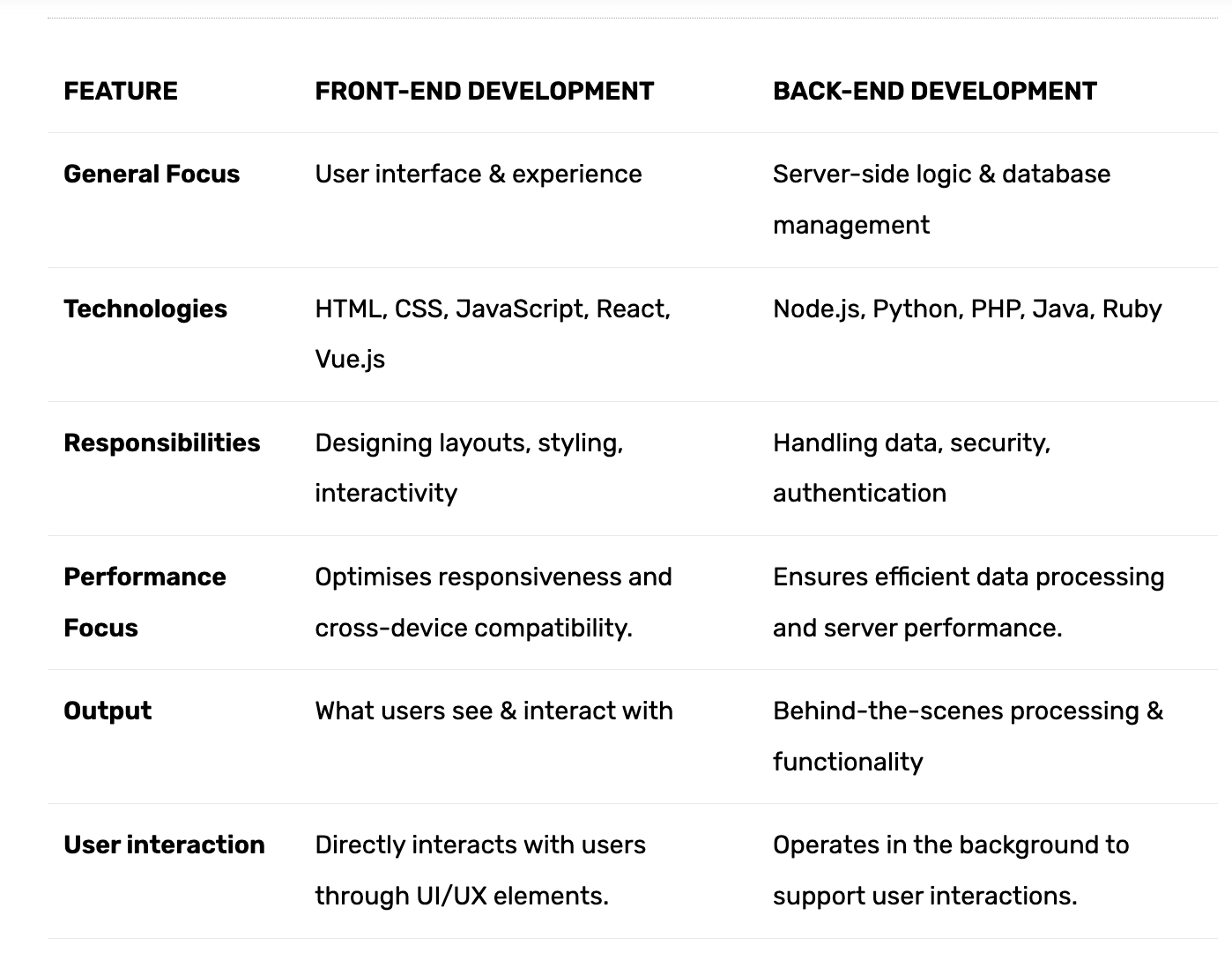
Front-end developers employ technologies like HTML, CSS, and JavaScript to curate visually appealing web interfaces. On the other hand, back-end developers oversee the databases, server-side logic, and application features that enable these user interfaces.
In essence, while front-end developers draw consumers in with visually appealing designs, back-end developers supply the infrastructure required to sustain a website’s functionality and performance. This is where the synergy between front-end and back-end development lies.
The key distinctions between both disciplines are summarised below:
Front end vs back end developer demand
The growing reliance on digital platforms across a range of industries is driving a large global demand for front-end and back-end developers. Evans Data Corporation's Worldwide Developer Population and Demographic Study projected that by 2024, there would be 6.69% more software developers worldwide.
Software developers are predicted to increase by 18% in the US alone between 2023 and 2033, creating over 304,000 new jobs during that time.
As Malaysian companies seek to augment their online presence through e-commerce and AI, we expect to see a more competitive landscape for developers. In fact, the demand for competent developers is being fuelled by the Malaysian government's promotion of programs to strengthen the digital economy.
The result of this aggressive push has been a thriving job market for aspiring developers, exemplified by an uptick in local job site postings. However, developers need to keep abreast with new tools and best practices as technology advances in order to remain competitive.
Back end vs front end developer salary
The rising need for tech skills in the digital economy is reflected in Malaysia's front-end and back-end developer compensation environment. Front-end developers can make between RM 3,000 and RM 8,000 a month— depending on their experience and skill set.
Back-end developers generally command higher salaries, ranging from RM 10,000 to RM 16,000. Arguably, the intricacy of back-end development activities calls for a greater understanding of systems architecture and security—hence, the salary gap.
Full-stack development: The best of both worlds
The term "full-stack development" describes the extensive procedure for planning, creating, and overseeing a web application's front-end and back-end components. In essence, a full-stack developer is capable of handling everything from database interactions and server-side logic management to user interface development. Full-stack development frequently leverages various technological stacks, such as:
- LAMP (Linux, Apache, MySQL, PHP)
- MERN (MongoDB, Express.js, React, Node.js)
- MEAN (MongoDB, Express.js, Angular, Node.js). Each stack offers a unique collection of frameworks and technologies that developers may utilise to quickly and effectively create reliable applications.
Generally, full-stack developers are highly valued by businesses for a number of reasons. They can execute modifications to both front-end and back-end systems without depending on different experts. This is because they can operate across the full technological stack, which increases flexibility and speeds up development processes.
This capability lowers project costs and time-to-market for new features or products— in addition to streamlining team communication. Furthermore, full-stack engineers have a comprehensive grasp of how various application components work together. This helps them troubleshoot problems more successfully and contribute to projects' overall success.
Which career path should you choose?
The career decision between front-end and back-end development may come down to one’s personal preferences and skills. However, front-end development is perfect for creative individuals interested in user interface (UI) and user experience (UX) design.
It strongly appeals to graphics-oriented individuals who love to create eye-catching layouts, animations, and interactive components.
Back-end development, conversely, is better suited for individuals with skills in logic, problem-solving, mathematics, security and database administration. These background competencies enable them to be proficient in languages like Node.js, Python, PHP, and Java.
Overall, the increasing need for front-end and back-end developers is a sign of a thriving labour market. In fact, as Malaysian companies turn to digital solutions, there will be an overwhelming demand for qualified developers in both fields.
Better yet, full-stack engineers who can bridge the gap between front-end and back-end development will certainly become hot cake. So, it might be ideal to strive for full-stack engineering competencies.
Conclusion
In conclusion, front-end and back-end developers have disparate but complementary duties. The client side—which includes everything users see and interact with—is the responsibility of front-end developers. They employ technologies like HTML, CSS, and JavaScript to produce beautiful interfaces and guarantee a flawless user experience.
Additionally, they exploit frameworks like Vue.js, Angular, and React to improve functionality and streamline development procedures.
On the other hand, back-end development revolves around the management of databases, server-side logic, and application features that assist the front end. In essence, backend developers guarantee the stability and effectiveness of the front end's supporting infrastructure. They employ programming languages like Python, Java, Ruby, or PHP to create APIs and manage data processing.
Overall, backend and front-end developers methodically collaborate to construct websites that are functional and easy to use. If you’re a business with AI or e-commerce ambitions, harnessing the power of front-end and back-end developers is mission-critical.
Explore our web and mobile app development services at Techies, where we combine these competencies to create robust applications tailored to diverse client needs.
About Author
Kok Weng
Kok Weng Kong is a tech enthusiast and problem-solving expert with a passion for technology and innovation. As the Founder & CEO of Techies App Technologies Sdn. Bhd., he specializes in building beautiful web and mobile applications and providing branding and marketing solutions for businesses. With a background in Information Technology and extensive experience in the industry, Kok Weng Kong excels in creating innovative solutions for various tech challenges.


Digitizing businesses since 2017


© 2026 Techies | All rights reserved