
AI Solutions: How eCommerce, Fintech, and Healthcare Mobile Apps Are Leveraging AI
 By Kok Weng•Published at 29 Jul, 2025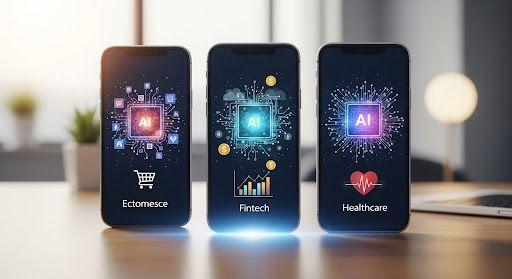
Key Takeaways
- AI is transforming mobile apps across eCommerce, fintech, and healthcare by enhancing personalisation, automation, efficiency, and real-time decision-making.
- In eCommerce, AI enables tailored recommendations, dynamic pricing, visual search, and smart inventory control, boosting customer satisfaction and sales.
- In Fintech, AI powers fraud detection, robo-advisory services, automated support, and inclusive credit scoring, making finance more secure and accessible.
- In Healthcare, AI enhances diagnostic accuracy, remote monitoring, virtual assistants, and predictive analytics—improving patient outcomes and access to care.
- AI integration benefits include operational efficiency, user satisfaction, innovation scalability, and stronger compliance in regulated industries.
- Challenges include data privacy, ethical use, model bias, and the need for human oversight—necessitating secure, transparent, and compliant development.
Introduction
Artificial Intelligence is ushering in a new era of smarter mobile applications across different traditional industries. This transformative shift is evident in how apps now offer hyper-personalised recommendations, instant support, and enhanced security features.
In industries like e-commerce, fintech, and healthcare, digital users are constantly seeking smoother, personalised, and safer experiences. Their appetite is insatiable! However, AI can help meet these ever-rising expectations. In fact, AI can set new standards for what’s possible in user experience and operational excellence.
This informational blog will examine exciting AI-driven developments and applications across Fintech, healthcare, and agriculture. It will also provide insights into how AI is fuelling innovation across mobile app development lifecycles—advancing the baseline state-of-the-art in these important sectors.
AI applications in mobile apps
AI elements are being incorporated into mobile apps to augment user engagement, personalisation, and predictive functionality. In fact, AI integration within mobile apps often results in new benchmarks for user experience across diverse sectors.
This is because AI-driven mobile apps push the technological boundaries of what’s possible. Thereby, delivering more intuitive, responsive, and intelligent digital experiences that keep businesses ahead of the curve.
AI in eCommerce mobile apps
AI is disrupting the eCommerce landscape by ushering in unprecedented levels of personalisation, data interactivity, and innovation. In fact, it’s fundamentally reshaping how retailers engage with their customers.
Here are some examples of how eCommerce mobile app development showcasing how enterprises are leveraging AI integrations and are experiencing boosted sales and customer retention
Personalised recommendations
AI-driven eCommerce algorithms can make tailored recommendations, examine a user's browsing patterns, past purchases, and preferences. Over time, these models get more intelligent and precise by continuously learning from user behaviour. This improves customer satisfaction, raises conversion rates, and promotes user engagement.
Chatbots & virtual shopping assistants
Chatbots and virtual shopping assistants driven by AI are transforming eCommerce by offering round-the-clock, immediate client service. They can process returns, respond to questions, and assist users in finding products. In addition to improving user experience, these AI conversational interfaces appreciably lighten the workload for customer service representatives.
Dynamic pricing & inventory management
AI systems can programmatically monitor consumer demand, rival pricing, and market trends in real-time to dynamically optimise eCommerce prices. Similar to this, AI forecasts stock needs by examining past data and present patterns. Thus, assisting companies in preventing stockouts or overstock scenarios and enhancing operational effectiveness and profitability.
Visual search
By exploiting computer vision mechanisms, visual search technology allows users to find similar items by uploading an image rather than inputting keywords. This AI capability greatly enhances the mobile shopping experience by making it easier for customers to find desired products— even if they are unsure of the brand or model. Here are some real-world examples:
- Amazon: Maintains generative AI chatbots for customer support, predictive shipping, and tailored product recommendations.
- Shopify: Provides merchants with AI tools, such as Shopify Magic, to generate product descriptions and targeted email marketing.
- eBay: Leverages visual search driven by AI to allow visitors to locate items by using images as a ‘search query’.
- Sephora: Beyond virtual ‘try-ons’, it offers tailored product recommendations through its app using AI and a chatbot for beauty guidance.
- Walmart: Leverages a proprietary AI in its mobile app for tailored search results, inventory control, and dynamic pricing.
AI in Fintech mobile apps
AI is fundamentally reshaping how financial services are delivered and experienced. This disruptive force of innovation is making financial services more accessible, convenient, and secure. Here are some ways it’s driving a new era of user-centric, data-driven financial management.
Fraud detection & risk management
AI is rapidly transforming how bankers and wealth managers approach fraud and risk management globally. AI can programmatically identify suspicious activity to safeguard financial institutions from bad actors. In practice, machine learning models can instantly highlight anomalous transactions based on trends, then send out immediate alerts. This proactive strategy significantly lowers financial losses for FinTech companies.
Personalised financial advice
AI-powered robo-advisors provide personalised financial advice based on a person's income, spending patterns, objectives, and risk tolerance.
They can also dynamically adjust recommendations and asset allocations to optimise returns whilst minimising risk. This level of hyperpersonalization makes wealth management more accessible and affordable, whilst empowering users to achieve their financial goals with greater confidence.
Credit scoring
Traditional credit scores often overlook valuable data. However, AI-driven fintech apps exploit alternative data sources—like utility payments, social behaviour, or transaction patterns—to evaluate creditworthiness. Consequently, they are able to deliver faster, more inclusive, and often fairer credit assessments. Thereby, expanding financial access to underserved populations.
Automated customer support
Virtual assistants and AI chatbots manage a variety of customer care responsibilities in financial apps, such as answering frequently asked questions, settling conflicts, and helping with transactions. In addition to lowering operating expenses and significantly improving response times, they are available 24/7. **Here are some real-world examples: **
- PayPal: PayPal combats financial crime by leveraging a proprietary AI engine to analyse transaction patterns in real time. Thereby, flagging suspicious activities and reducing fraud losses.
- Robinhood: Robinhood integrates AI to avail on-the-fly insights and personalised strategies. Its AI also provides dynamic risk management capabilities and detects potential risks in user accounts. Thereby, helping engage users while protecting their assets.
- Wealthfront: Wealthfront deploys AI-powered robo-advisors to deliver customised investment strategies and financial planning based on individual goals and risk profiles. Thus, making wealth management more accessible and user-centric.
- Chime: Chime applies AI to programmatically monitor account activity, automatically alerting users to unusual spending behaviour. Thus, helping them stay on top of their finances.
- Klarna: Klarna exploits advanced AI to power real-time fraud detection by assessing customers’ creditworthiness in real-time.
AI in Healthcare mobile apps
AI is elevating how care is delivered, managed, and experienced by both patients and providers. Its integration with mobile health solutions promises to not only improve outcomes and efficiency but also democratise access to high-quality care. Here are some ways AI is making healthcare more patient-centric, interactive, and data-driven than ever before.
Remote patient monitoring
AI-driven apps can continuously track one’s heart rate, blood pressure, and oxygen levels. If they identify abnormal data, these apps can notify medical professionals instantly. Thus, enabling quicker interventions and improved chronic illness management without the need for frequent hospital stays.
Virtual health assistants and diagnostic support
AI-powered chatbots can serve as virtual health assistants, effectively handling several repetitive tasks. For instance, reminding users to take their medications, providing basic diagnosis advice, and responding to health-related questions. This consequently translates into increased patient participation and proactive self-care, reducing the strain on healthcare systems.
Predictive analytics for diagnosis
Predictive AI analytic tools can identify possible health risks by analysing genetic data, lifestyle factors, and patient history. Consequently, these systems can generate early alerts that assist physicians in making proactive decisions. Thereby, enabling preventative care and individualised treatment plans before diseases worsen.
Medical image analysis
Apps with AI capabilities can quickly and accurately scan and analyse medical pictures, such as MRIs, CT scans, and X-rays. This capacity to shorten diagnosis timeframes and facilitate more precise clinical judgments is especially critical in emergency situations where timely intervention can save lives.
Overall, AI image analysis improves patient outcomes by minimising human error and providing consistent, high-quality results regardless of workload. **Here are some real-world examples: **
- Ada Health: This AI-powered symptom checker, optimised by clinicians, helps users understand their symptoms and guides them toward appropriate care.
- The Da Vinci Surgical System: This groundbreaking robotic AI tool allows surgeons to perform intricate, minimally invasive procedures with greater accuracy and flexibility.
- Babylon Health: This symptom-checking AI chatbot facilitates virtual consultations, symptom checking, and health monitoring. Thereby, making healthcare more accessible and proactive.
- Sensely: This empathy-driven conversational AI delivers 24/7 patient support, symptom checking, and personalised health advice. Thus, appreciably improving patient engagement.
- MD Anderson: This Cancer Center leverages advanced AI to analyse pathology slides and genomic data. Thus, enabling highly personalised cancer treatment plans whilst advancing patient care and cancer research.
Key benefits of integrating AI across these industries
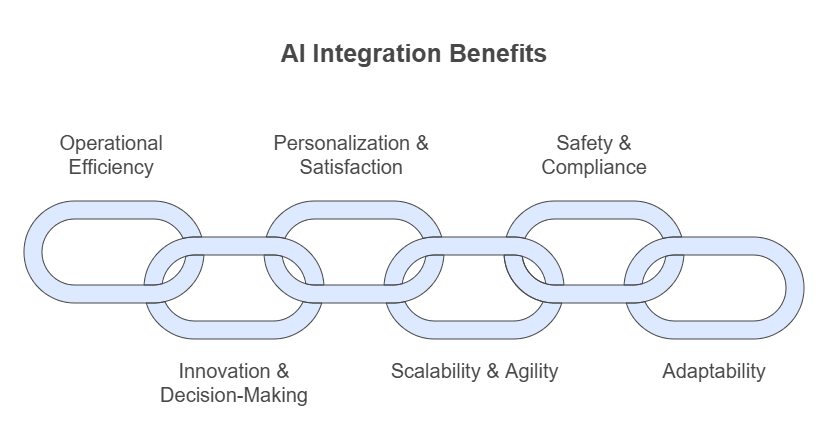 The benefits of integrating AI across FinTech, eCommerce, and Health industries can be summarised as:
- Enhanced operational effectiveness and cost savings via process optimisation, predictive analytics, and automation of repetitive processes. This consequently allows companies to accomplish more with fewer resources.
- Accelerated innovation and data-driven decision-making since AI supports improved strategic planning and competitive advantage.
- Increased personalisation and user satisfaction, as AI tailors products, services, and experiences to individual preferences. Thus, driving higher engagement and loyalty.
- Increased scalability and agility, enabling businesses to grow and react swiftly to market changes without having to increase expenses.
- Improved safety, security, and compliance through AI-driven risk assessment, fraud detection, and regulatory monitoring. This is particularly beneficial in sensitive industries like healthcare and finance.
- Quick adaptation to changing consumer expectations and technology breakthroughs, thereby future-proofing apps for market demands.
Challenges and considerations of integrating AI in mobile apps
The ethical application of AI and data privacy are two major challenges when integrating AI into mobile apps. To protect sensitive data, developers must apply strong encryption and anonymisation protocols. They should also ensure user data is gathered, kept, and processed responsibly while abiding by laws like the GDPR. Developers should also design transparent, equitable, and responsible AI systems since AI’s unforeseen effects can raise ethical concerns. AI models must also be continuously trained and updated in order to preserve security and address biases in models. Lastly, even though AI automation might increase productivity, human oversight is essential to identify mistakes and stop abuse.
Also read: Overcoming the Top 5 Challenges of AI Integration in Mobile Apps
How to choose the best AI mobile app integration services?
Because AI technology is always changing and intrinsically complicated, selecting the right AI integration service is a decision that carries significant weight for any business.
Identifying proven professionals helps you protect your investment and lowers operational risks. It also puts your company in a position to take full advantage of AI's revolutionary potential for long-term growth and user satisfaction.
As such, it’s imperative that you choose a reputable and experienced firm.
At Techies, we ensure that all our AI mobile app integration projects are executed with industry best practices, compliance, and security in mind. In fact, our in-depth knowledge of the AI state-of-the-art is second to none. It enables us to unlock AI’s potential value to deliver scalable solutions that maintain your app's competitiveness in the market.
Conclusion
Artificial Intelligence (AI) has emerged as a seismic, disruptive force, fundamentally reimagining how we live and work across multiple domains. In eCommerce, AI is transforming the shopping experience through personalised product recommendations and dynamic pricing.
Relatedly, in FinTech, AI is revolutionising customer support, credit scoring and fraud detection. Thereby, collectively making online shopping more efficient, engaging, and secure. Meanwhile, in healthcare, it’s enabling entirely new possibilities across early disease detection and real-time health monitoring.
Businesses that adopt AI now gain a competitive advantage, surpassing evolving consumer demands.
Reach out to us at Techies for AI mobile app integration and development services to maximise AI value and strategise a scalable and future-ready approach to digital innovation.
About Author
Kok Weng
Kok Weng Kong is a tech enthusiast and problem-solving expert with a passion for technology and innovation. As the Founder & CEO of Techies App Technologies Sdn. Bhd., he specializes in building beautiful web and mobile applications and providing branding and marketing solutions for businesses. With a background in Information Technology and extensive experience in the industry, Kok Weng Kong excels in creating innovative solutions for various tech challenges.


Digitizing businesses since 2017


© 2026 Techies | All rights reserved