
Guide In Choosing The Best Mobile App Development Company For Your Business
 By Kok Weng•Published at 19 Dec, 2025•Updated 23 Dec, 2025
Key Takeaways
- A mobile app is a strategic asset—choose a partner who understands your goals, not just code.
- Research companies’ portfolios, client reviews, and relevant case studies before shortlisting.
- Evaluate their technical expertise in iOS, Android, and cross-platform frameworks like Flutter or React Native.
- Ensure a clear, agile development process with transparent communication and defined milestones.
- Prioritise user-focused UI/UX design for better engagement and retention.
- Clarify full project costs, including hidden and post-launch maintenance fees.
- Confirm long-term app support, updates, and security best practices like encryption and monitoring.
- Look for partners who integrate analytics, ASO, and monetisation strategies to drive growth.
- Assess scalability, framework suitability, and realistic timelines to future-proof your app.
- Treat your developer as a long-term partner who contributes to innovation and sustained success.
Introduction
Mobile apps have quietly become the backbone of how businesses connect, sell, and grow. They’re no longer just a “nice-to-have” but a strategic asset. In fact, for many companies, a mobile app is the front door to their brand.
Still, building a successful app isn’t as simple as hiring a coder and waiting for magic. It’s about finding a partner who understands what you’re trying to achieve. The right mobile app development company can shape your brand’s reputation.
They can also help you retain users and even open new revenue streams. In stark contrast, the wrong one can drain your budget and delay your goals.
This guide aims to walk through the process of choosing a prospective partner wisely. It seeks to cover how to spot a skilled, reliable development team, what to ask, and what to avoid.
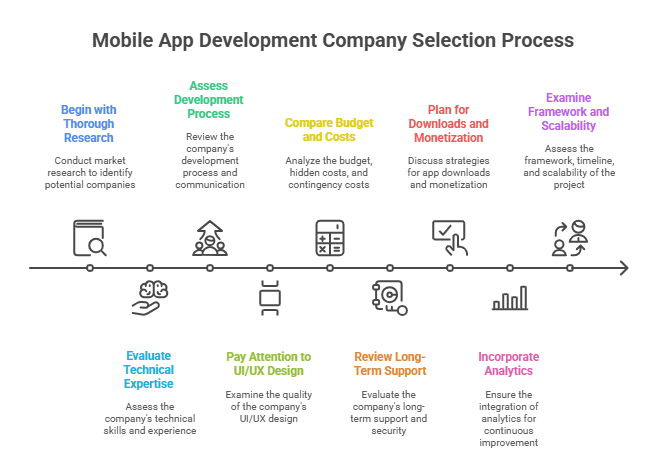
Step 1: Begin with Thorough Mobile App Company Research
Start where all good decisions start—with market research. Before you sign a contract, extensively look at who’s out there and what they’ve built.
A good shortlist begins with firms that have solid portfolios and happy clients. Check out their case studies that detail past work. Furthermore, look for mobile apps they’ve built that resemble your idea. Visit app stores to see how those apps perform and what users say about them.
Additionally, look out for evidence-based testimonials.
Testimonials and case studies reveal more than marketing talk. They show if a company consistently delivers on promises. So, investigate how they solved client problems, their design quality, and post-launch support.
Lastly, substantiate their expertise—whether they build native apps, hybrid, or cross-platform solutions. Such a thorough evaluation ensures their technical skills match your project requirements.
Step 2: Evaluate Technical Expertise and Experience before Outsourcing Mobile App Development
Technical skill matters. But so does how that skill is applied.
So, always ask potential partners about the iOS and Android development tools and languages they leverage. Most native apps are built with Swift (for iOS) or Kotlin (for Android). Cross-platform frameworks often include Flutter or React Native, which can speed up development without compromising performance.

Besides having background information on native and cross-platform development, knowing your audience helps shape this decision. If your customers are mostly iPhone users, iOS development considerations should be prioritised. If they’re spread across regions where Android dominates, then that’s where you begin.
A good development company will guide you through this logic rather than simply agreeing to whatever you say. Experience also shows in how they estimate time and structure your project. A team that has built similar apps can usually outline a practical roadmap—not an overpromised one.
If you’re outsourcing, also look for a company that has handled international projects. Communication styles differ, time zones can be tricky, and cultural context matters. A partner who already knows how to bridge those gaps will make collaboration much smoother.
Also read: Mobile App Development Outsourcing in Malaysia (Guide and Tips)
Step 3: Assess the Development Process and Communication Workflow
Even the most talented developers can fail without a transparent structure. One should always have a clear view of how a project will move from ideation to launch. This often ensures fewer surprises and smoother execution.
An executable mobile app development process usually follows defined stages: Discovery → Design → Prototyping → Development → Testing → Launch → Post-launch Support.
Each methodical step should involve feedback, revisions, and checkpoints. When you know what’s happening at each phase, there’s less room for confusion or missed expectations.
So, always inquire how the company manages communication regarding progression and updates. Do they use tools like Jira, Trello, or Slack? Will you get weekly updates? Open collaborative communication lines prevent the silent gaps that cause frustration later.
Most competent companies leverage an agile methodology. This methodology means short development cycles with frequent feedback. It keeps things flexible if your priorities shift mid-project.
Step 4: Pay Attention to UI/UX Mobile App Design and Quality of Design
You can build a powerful app that no one enjoys using—if the design misses the mark. Design isn’t just about colour or style. It’s about how users feel when they interact with your app.
Good UI/UX mobile app design directly influences user retention and engagement. It creates a sense of ease. Menus should guide, not confuse. Buttons should be easy to reach. Animations, when used, should support the experience.
So, before you commit to a mobile app development company, ask to see design samples or prototypes. Pay attention to the quality of their existing designs—intuitive navigation, visual consistency, and responsiveness across devices. Some developers can even walk you through the user journey with clickable demos.
Also, check how their designs perform across disparate devices. A layout that looks perfect on an iPhone 15 should still feel natural on a mid-range Android. Consistency matters in design quality. It often reflects the company’s overall care. If they take shortcuts here, they’ll likely cut corners elsewhere.
Step 5: Compare Mobile App Development Budget, Hidden Costs, and Contingency Costs
Budget talks can sometimes be awkward, but they’re essential. Many businesses start with one number in mind and end up spending double. This is often because the initial estimate or quote left out key details.
So, always consider development costs spanning all phases—from ideation and discovery through design, development, testing, launch, and ongoing post-launch maintenance.
As a guide, typical budgets allocate around 10-15% for discovery and strategy. They also set aside 20-25% for design, 40-55% for development coding, and 15-20% for testing and deployment.
Such a comprehensive approach ensures your budget reflects the app’s full lifecycle, not just the initial build. Hidden costs can appear as subscription fees, third-party service costs, or unplanned bug fixes. So, always ask, “What’s not included here?”
Ensure to also set aside contingency funds for updates or new features. Remember to always request a transparent breakdown of pricing, deliverables, and support terms. The real goal is assessing value and return on investment (ROI).
Step 6: Review Long-Term Support, Maintenance and mobile app security factors
Long-term support, maintenance, and security are mission-critical to keeping a mobile app reliable, secure, and optimised over time.
Ongoing technical support ensures that an app remains compatible with new operating system updates, devices, and third-party integrations. This consequently prevents performance degradation or security vulnerabilities that could harm user trust.
Security is one area where you can’t afford shortcuts. Regular mobile app security updates, bug fixes, and performance enhancements help sustain user engagement and loyalty. Thereby, increasing the app’s lifetime value whilst adapting to changing market needs—providing continuous competitive advantages.
So, always ask what protections prospective developers use—encryption, secure APIs, authentication, and server monitoring. One weak link can cost you user trust. Generally, the best partners think long-term whilst treating your app as an evolving product.
Step 7: Plan for Mobile App Downloads and App Monetisation
An app without users can be catastrophic. As such, any prospective development partner should know how to boost downloads via app store optimisation (ASO) and marketing integrations.
App store optimisation (ASO) is critical to improving mobile app downloads and visibility. It involves methodically optimising metadata like app titles, keywords, descriptions, icons, screenshots, and videos to attract organic traffic and increase conversion rates.
Your development partner should be able to integrate app monetisation strategies, such as in-app purchases, subscriptions, or ads, without compromising user experience. This will allow you to generate revenue effectively whilst enabling better architecture and scalability.
Overall, a capable partner ensures you maximise both downloads and revenue potential via technically sound and customer-focused implementations.
Step 8: Ask to Incorporate Mobile App Analytics for Continuous Improvement
Once your app launches, data becomes your guide.
Mobile app analytics show how people utilise your app—what they like, where they leave, and what features they engage with most. These insights drive better decisions. You can adjust design, reduce churn, fix weak points, and plan updates that matter.
So, ask prospective developers if they possess the competence to integrate analytics dashboards or tools like Google Firebase or Mixpanel. These tools allow real-time tracking of user behaviour via metrics such as active users, session duration, conversion rates, and crash reports.
Remember, data is digital gold. It helps tailor user journeys, personalise marketing, and prioritise feature enhancements strategically. Thus, ensuring the app evolves effectively with user needs.
Step 9: Examine Framework, Timeline, and Project Scalability
Every mobile app project needs a clear framework and timeline. These shape speed, flexibility, and future scalability. For context, frameworks like Flutter, React Native, and Kotlin Multiplatform each offer distinct advantages based on your app’s requirements.
For instance, Flutter provides near-native performance with a single codebase and highly customisable UI widgets. React Native excels in apps needing heavy integration with web technologies. Understanding these options early helps avoid technical debt, avert delays, and future-proof the app for growth and new features.
So, ask your development company which technology stack they recommend. The right choice affects app performance, maintenance, and scalability. Furthermore, timelines should match your goals. A short timeline may work for a minimum viable product (MVP), while a large app may need months.
So, if a company promises delivery in half the usual time, ask how. Speed without clarity can signal corner-cutting. Do they also have processes for iterative releases, integration expansions, and scalability planning? Your app might start small, but can it handle more users later?
Conclusion
Choosing the right mobile app development company is one of the most important decisions your business can make. The right partner builds more than an app—they help shape your digital future. So, when comparing companies, focus on these key factors:
- Proven experience and strong technical skills.
- A transparent and collaborative development process.
- High-quality UI/UX mobile app design.
- Clear budgeting with no hidden costs.
- Reliable long-term support and security measures.
- Growth planning with analytics, monetisation, and scalability.
Treat this as a partnership, not a transaction. The best developers care about your goals as much as you do. Techies not only deliver your initial vision but also evolve your app with business growth, market shifts, and technology advances.
Choosing the right mobile app development company means investing in innovation, stability, and user experience that grows with your business. So, reach out to us at Techies now!
About Author
Kok Weng
Kok Weng Kong is a tech enthusiast and problem-solving expert with a passion for technology and innovation. As the Founder & CEO of Techies App Technologies Sdn. Bhd., he specializes in building beautiful web and mobile applications and providing branding and marketing solutions for businesses. With a background in Information Technology and extensive experience in the industry, Kok Weng Kong excels in creating innovative solutions for various tech challenges.


Digitizing businesses since 2017


© 2026 Techies | All rights reserved