
What is Android App Development?
 By Kok Weng•Published at 25 Jul, 2025
Key Takeaways
- Android holds around 72% global and 67.6% Malaysian market share, making it a strategic choice for mobile app development.
- It powers smartphones, tablets, TVs, wearables, and automotive systems—enabling innovation across diverse device types.
- Businesses can choose from native, cross-platform, hybrid, or PWA development based on performance needs, budget, and time-to-market.
- Effective Android app development follows a six-phase lifecycle—from planning and design to deployment and post-launch support.
- Developers rely on Android Studio, Kotlin, Java, Flutter, React Native, Firebase, and local payment integrations like iPay88 or Maybank.
- Development cost depends on app complexity, design, platform choice, third-party integrations, and location of the development team.
Introduction
Android fundamentally transformed the way we interact with technology. It democratised smartphone access, enabling the creation of diverse devices that cater to all budgets and preferences. This accessibility seismically revolutionised mobile connectivity.
In fact, Android expanded beyond the realm of smartphones to power tablets, wearables, smart TVs, and even automotive systems. It has fuelled the growth of app ecosystems, fostering innovation in areas like mobile gaming, health tracking, and mobile payments. Its flexibility and scalability are also facilitating the quick adaptation of emerging technologies, such as augmented reality and AI.
Currently, Android dominates the global mobile operating system market with a commanding share of approximately 72%.
In Malaysia, Android similarly leads with around 67.6% market share. This dominance can be attributed to its inclusive ecosystem, cost-effective devices, and adaptability to varying consumer needs.
What is Android?
Developed by Google, Android is an open-source mobile operating system that’s primarily intended for touchscreen devices like smartphones and tablets.
Android OS began in 2003 as a startup called Android Inc. The company initially sought to develop an operating system for digital cameras before pivoting to mobile devices. Google later acquired Android Inc. in 2005, transforming it into an open-source platform to promote innovation and flexibility in mobile computing.
In practice, several layers make up Android's architecture. These layers include the Linux kernel, hardware abstraction layer, Android Runtime, native libraries, and an application framework. Because it supports disparate hardware platforms and networking protocols, it can be used with a large variety of devices around the world.
Android vs Other Mobile Platforms
- Android vs iOS: In 2025, Android dominates globally with approximately 72% market share compared to iOS’s 28%. While iOS leads in wealthier markets like the U.S, Android is undisputed in Asia and Africa. Furthermore, developing iOS apps tends to be more expensive than developing Android apps. This is primarily due to fewer devices, Apple’s annual developer fee, and stricter app store guidelines.
- Why Android First? Android allows businesses to reach a larger and more diverse global audience due to its extensive device ecosystem. This broad accessibility translates into higher potential user engagement and ROI, especially in emerging markets.
- Device Fragmentation: Android’s open-source nature and device heterogeneity create different fragmentation challenges. For example, multiple OS versions, hardware differences, and manufacturer customisations. However, this diversity also offers opportunities for innovation across many device types. Thereby, enabling developers to tap into a broad and varied market despite the complexity.
Types of Android App Development
Android app development can be segmented into four main categories, depending on project needs, budget, performance expectations, and time-to-market goals.
Native Android Development
Native Android development revolves around building apps using programming languages like Java or Kotlin. This development approach offers the best performance and provides full access to all device features. Thereby, resulting in a superior user experience tailored to Android devices.
However, native development typically incurs higher costs and dictates creating a separate version for iOS, thus, increasing overall development time and resources.
Overall, native Android development is generally best for high-performance apps (e.g., games, AR/VR) and applications with intricate UI/UX or hardware interactions.
Cross-Platform Development
Cross-platform development essentially revolves around creating a single codebase that works on both iOS and Android. Thereby, greatly accelerating development and cutting expenses.
In practice, this approach leverages platforms like React Native, a JavaScript framework for building native-like apps using React. It also employs Flutter, a cross-platform UI toolkit by Google that exploits the Dart programming language.
Because of its effectiveness and robust community support, this approach is preferred by SMEs and startups in Malaysia. Generally, this development approach is best for projects with limited budgets but medium complexity.
Hybrid App Development
Hybrid apps are constructed using web technologies like HTML, CSS, and JavaScript. Afterwards, they are wrapped in a native container (like Apache Cordova or Ionic) to run across multiple platforms.
This cost-effective development approach allows faster deployment. However, it often sacrifices performance and user experience compared to native apps.
Generally, it suits projects needing quick market entry with moderate functionality. For example, content-driven apps or internal business tools.
Progressive Web Apps (PWAs)
PWAs are web applications engineered to behave like native apps. They offer offline capabilities, push notifications, and homescreen installation, without requiring app store downloads.
They are beneficial for businesses with existing websites desiring to augment mobile engagement cost-effectively. However, they have limitations in accessing certain device features and may not deliver the same performance as fully native apps.
The Android App Development Process
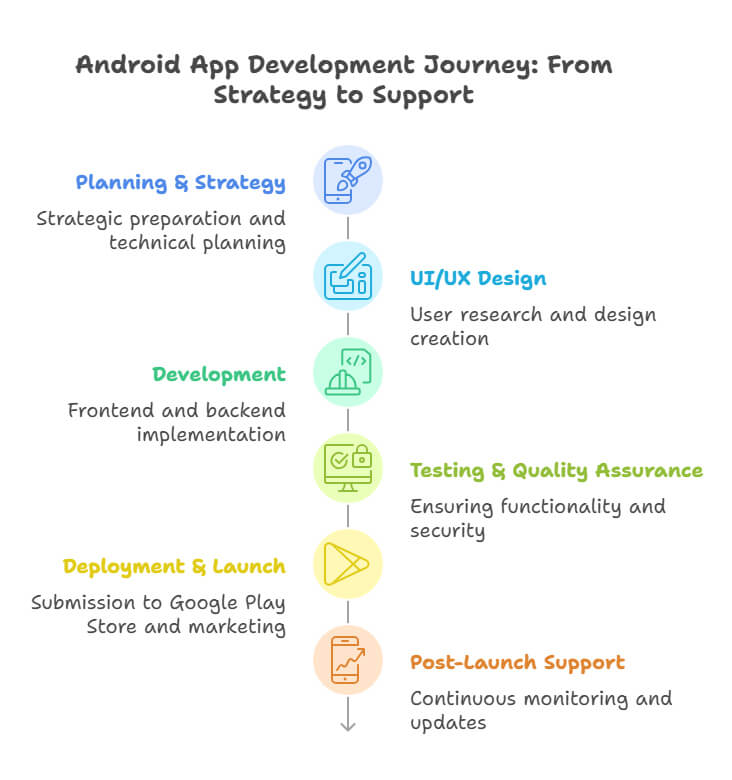
Iteratively developing an Android app involves several systematic phases to meet business goals and user expectations. For example:
Phase 1: Planning & Strategy
The process of developing an Android app starts with careful strategy and preparation. Understanding the target audience, feature prioritisation, and performing competitive analysis are usually the first strategic steps.
The next technical planning steps include choosing the technology stack, deciding on the app architecture, and estimating reasonable budgets and schedules. This preparatory work guarantees that the project is in line with both technical viability and business objectives.
Phase 2: UI/UX Design
In this phase, user research is conducted, tailored to the target region. For example, one can perform user research into the Malaysian market to capture local preferences and behaviours.
This stage also entails the creation of wireframes and prototypes to visualise app flow and functionality before development. This UI/UX design process should adhere to Android’s Material Design principles, ensuring a consistent and intuitive interface.
Furthermore, responsive design techniques must be employed to accommodate various screen sizes and device types. Accessibility considerations are also integral to making the app usable by people with disabilities.
Phase 3: Development
This phase typically commences with setting up the appropriate environment and tools. In practice, the development phase can be broken down into frontend and backend development.
The frontend development phase focuses on implementing the user interface and iteratively optimising the user experience for smooth interaction. Backend development revolves around server setup, API creation, database design, and cloud integration.
Additionally, this phase might involve third-party integrations. Here, companies can integrate popular Malaysian payment gateways, social media platforms, and analytics tools to augment app capabilities.
Phase 4: Testing & Quality Assurance
This phase ensures the app works consistently in every situation. Functional testing confirms that features function as intended, whereas performance testing evaluates responsiveness and speed.
Relatedly, device compatibility testing ensures the app functions properly across diverse Android devices and OS versions. Security testing safeguards user data and app integrity.
Before the formal launch, beta testing is conducted to pinpoint problems, while User Acceptance Testing (UAT) involves actual users verifying the app's suitability.
Phase 5: Deployment & Launch
This post-testing phase mainly revolves around the submission of the app to the Google Play Store. Typically, App Store Optimisation (ASO) techniques are strategically implemented to improve visibility and downloads.
Furthermore, compliance with Google’s policies and local regulations is verified to avoid rejection. Afterwards, a well-planned launch strategy is executed. This is often accompanied by marketing and promotional activities to maximise user acquisition.
Phase 6: Post-Launch Support
Post-launch support is mission-critical to sustaining app success. This typically entails continuous monitoring and analytics to track user behaviour and app performance.
Additionally, developers may promptly address bugs and release updates. They might also execute feature enhancements to keep the app competitive and aligned with evolving user needs. Overall, ongoing maintenance ensures the app remains secure and compatible with new Android versions. For further reading, check out: Mobile Application Development Life Cycle (Phases & Steps)
##Android app development tools To effectively build an Android app, chances are that you will interact with the following development tools:
Programming Languages
- Java: This is considered Android’s traditional language and comes with extensive community support.
- Kotlin: This is Google’s preferred modern language for Android because of its concise syntax and enhanced safety features.
- JavaScript/TypeScript: This is primarily employed for cross-platform React Native development.
Development Frameworks
- Native: Android Studio and Android SDK provide comprehensive tools for engineering native Android apps.
- Cross-platform: React Native, Flutter, and Xamarin allow developers to construct apps for both Android and iOS using shared codebases.
- Hybrid: Cordova and Ionic wrap web technologies into native containers for expedient cross-platform deployment. Essential Tools & Services
- Development: Android Studio, Visual Studio Code (VS Code), and Git for coding, version control, and collaboration.
- Testing: Firebase Test Lab and Espresso for automated testing across disparate devices and scenarios.
- Analytics: Google Analytics and Firebase Analytics to programmatically track user behaviour and app performance.
- Cloud Services: AWS, Google Cloud, and Firebase offer scalable backend infrastructure and services.
- Payment Integration: Popular Malaysian payment gateways like iPay88, Maybank, and CIMB facilitate secure in-app transactions.
##Cost for Android app development The costs of developing an Android app vary greatly based on a number of important aspects. A significant factor is app complexity. Simple apps with few screens and basic functionality usually cost between $3,000 and $15,000.
Medium-complexity apps with custom user interfaces and API integrations cost between $10,000 and $50,000. Complex apps with advanced features like AI or real-time data syncing can cost over $100,000 and take more than eight months to develop.
Costs are also affected by design specifications. For example, highly unique UI/UX work is more expensive than template-based solutions. The choice of platform—native versus cross-platform—also affects budget. This is because cross-platform tools like Flutter or React Native can save expenses by 30–40%, whereas native apps often cost more but perform better.
Rates are also influenced by the development team's location and level of experience. Developers in countries like Malaysia are typically less expensive than those in North America or Europe.
Development costs may also be increased by integrating third-party services like analytics, social media, and payment gateways. Last but not least, to promptly address issues, regular maintenance and upgrades usually demand 15–20% of the original development budget each year.
For more reading, check out: Mobile App Development Cost Estimate in Malaysia (2023)Italic
How to choose the right Android app development services?
To guarantee project success, choosing an Android app development service necessitates careful assessment of key factors. For example, technical know-how, industry experience, development process, and post-launch assistance. Techies tick all these boxes with the following:
- Proven Track Record: Partnered with 30+ brands since 2017
- Local Expertise: Deep understanding of the Malaysian market and consumer behaviour
- Cross-Platform Specialisation: Skilled in React Native and Flutter for efficient development
- End-to-End Services: Comprehensive support from concept through launch and beyond
- Free Consultation: No-obligation initial discussion to align goals and expectations
Conclusion
The Android ecosystem is advancing by leaps and bounds. It is becoming more sophisticated with each new update and technological advancement. And with the advent of AI and evolving security threats, it’s imperative to find the right partner to build your Android application.
In fact, companies that fail to leverage Android’s advancements risk falling behind in today’s fast-paced digital landscape. Even worse, they risk missing opportunities to innovate their products and services.
Embracing Android app development is no longer optional for businesses seeking to remain competitive in a mobile-first world. Considering an Android app development for your business? Reach out to us at Techies!
About Author
Kok Weng
Kok Weng Kong is a tech enthusiast and problem-solving expert with a passion for technology and innovation. As the Founder & CEO of Techies App Technologies Sdn. Bhd., he specializes in building beautiful web and mobile applications and providing branding and marketing solutions for businesses. With a background in Information Technology and extensive experience in the industry, Kok Weng Kong excels in creating innovative solutions for various tech challenges.


Digitizing businesses since 2017


© 2026 Techies | All rights reserved