
How SMEs Can Leverage IoT Development Without Huge Upfront Investment
 By Kok Weng•Published at 23 Dec, 2025
Key Takeaways:
- IoT is no longer enterprise-only—cloud-native platforms and affordable hardware now make it accessible for SMEs.
- SMEs can start small with practical use cases like inventory tracking, energy monitoring, or remote alerts to validate ROI early.
- Pay-as-you-go cloud models (AWS, Azure) remove high upfront costs by eliminating on-premise servers and complex infrastructure.
- Affordable IoT strategies rely on modular solutions, existing devices, and incremental scaling rather than large upfront deployments.
- Pilot projects help SMEs gain measurable wins before expansion—reducing downtime, improving efficiency, and automating workflows.
- The right IoT partner ensures smooth integration, clear pricing, scalable architecture, and strong post-launch support.
Introduction
Having previously been an exclusive domain of large enterprises, IoT technology is fast becoming widely available to small and medium-sized organisations (SMEs).
Initially, the high price and complexity of IoT deployments confined its adoption. However, developments in sensor technology, connectivity options, and data analytics have democratized IoT. This has consequently enabled SMEs to exploit its benefits for operational efficiency, customer engagement, and real-time decision-making.
This accessibility can be credited to cloud-native platforms and flexible IoT partner developers. They enable small businesses to access advanced IoT capabilities without prohibitive upfront investments.
From pay-as-you-go models that eliminate costly maintenance fees to tailored applications and integration services, they help smaller firms implement IoT systems expeditiously. Thereby, driving widespread IoT adoption beyond the enterprise and empowering SMEs to compete and innovate in an increasingly connected world.
What’s Holding SMEs Back from Adopting IoT?
Despite the strategic benefits it offers, many SMEs primarily hesitate to adopt IoT due to:
- Fears around high hardware costs
- Complex setup processes
- Lack of in-house technical expertise.
To exacerbate things, there is a common misconception that IoT always involves expensive industrial robots. Or even multi-million ringgit systems, which can deter smaller businesses from exploring their benefits.
This could not be any further from the truth. In reality, IoT solutions can be tailored to fit smaller-scale operations—without massive investments or specialised equipment. However, the true challenge for SMEs lies more in scalability and strategic planning than just the initial budget.
For context, traditional IoT systems often dictated dedicated servers or on-premise infrastructure, creating significant barriers to entry. However, AWS platform providers and Azure platform providers now offer cloud-based IoT solutions that eliminate these obstacles.
In practice, these platforms provide flexible, scalable environments that SMEs can easily adopt. As a result, SMEs can focus instead on thoughtful, scalable growth.
How Can SMEs Start Small with IoT?
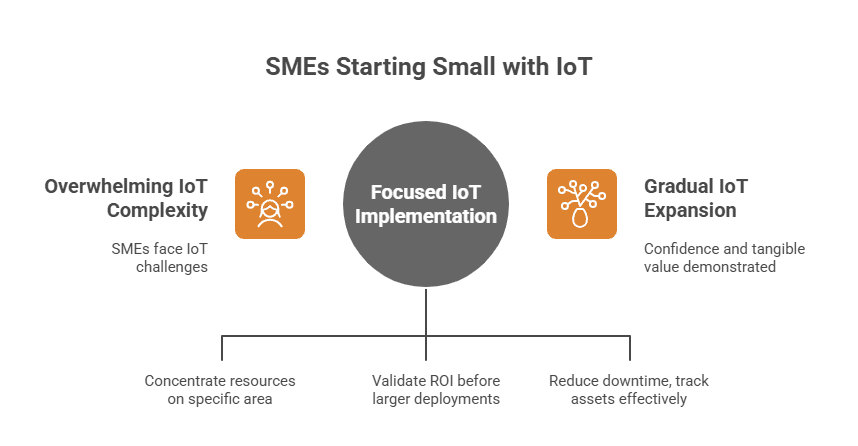 SMEs can commence their IoT journey by focusing on one practical use case. For example, inventory tracking, remote monitoring, or energy management. Fundamentally, this strategy regarding IoT application use cases allows businesses to concentrate resources on a specific area where IoT can deliver measurable benefits, without overwhelming complexity.
Furthermore, it helps SMEs gain hands-on experience while addressing immediate operational needs.
Pilot projects play a mission-critical role in validating ROI before committing to larger-scale deployments. For example, pilot projects can entail exploring lightweight cloud dashboards and IoT solutions for remote monitoring or inventory alerts. This can help SMEs test real-time data insights and automation with low upfront risk.
Consequently, SMEs can safely collect small wins—like reducing equipment downtime, tracking assets effectively, or automating alerts. Thereby, building confidence and demonstrating tangible value, paving the way for the gradual expansion of IoT across other departments.
What Does an Affordable IoT Approach Look Like?
In practice, an affordable IoT approach for SMEs often revolves around low-barrier models. For instance, subscription-based services or modular IoT solutions that reduce appreciably upfront costs.
Generally, these models allow businesses to pay as they grow, avoiding heavy initial investments. Additionally, SMEs can leverage existing devices like smartphones, sensors, and Wi-Fi routers to build IoT systems without the need for costly new infrastructure.
Relatedly, the concept of "build what you need, when you need it" reflects a flexible, incremental IoT adoption strategy where SMEs can scale gradually based on evolving business needs.
Fundamentally, these low-cost strategies enable businesses to avoid committing to heavy and extensive infrastructure from the outset. Instead, SMEs can scale step by step as value and demand increase.
Can Cloud Platforms Make IoT Affordable?
Cloud-based IoT systems make IoT affordable for SMEs by eliminating the need for pricey on-premise servers and heavy infrastructure. By eliminating the need for initial hardware purchases and continuing maintenance costs, these platforms allow companies to store, process, and manage IoT data remotely.
For instance, by leveraging cloud-native environments via AWS platform providers or Azure platform providers, SMEs benefit from scalable hosting. This hosting allows them to pay only for the storage, bandwidth, and processing they actually use. Thus, making the technology cost-efficient and accessible for smaller budgets.
For example, a retail store can utilise a simple cloud dashboard to monitor sales sensors in real time. This can allow them to optimise stock and reduce losses without complex setups. Similarly, a logistics firm can track its fleet through a mobile app connected to cloud services. Thereby, gaining insight into operations and improving efficiency.
Real-World Examples of SMEs Benefiting from IoT
A local café implemented IoT technology with temperature sensors connected to cloud-native platforms. The fundamental premise was to automatically adjust heating and cooling to optimise energy use. This consequently resulted in a 25% reduction in energy bills, appreciable cost savings, and improved sustainability—without manual oversight.
In the same vein, a logistics SME integrated GPS trackers and sensors into their fleet, leveraging IoT technology and cloud-native solutions for automated delivery updates. Consequently, drivers and customers received instant notifications on shipment status. This cut delivery delays, boosted customer satisfaction, and reduced fuel costs.
Relatedly, a factory can leverage IoT to power predictive maintenance alerts by deploying sensors to monitor equipment in real-time for anomalies. For example, vibration spikes, temperature rises, or performance shifts. Consequently, triggering proactive interventions before failures escalate.
One notable case study is Techies’ development of the CoffeeBot Operator App for a vending machine operator managing over 2,000 machines across Malaysia and Singapore. The IoT-enabled app featured real-time sales monitoring, remote control via APIs, and comprehensive reporting. Thus, appreciably reducing downtime and improving technician coordination for better efficiency.
**Read the full case study here: Coffee Bot IoT Development by Techies. **
How to Measure Success Before Scaling Further?
SMEs can measure IoT success through simple metrics. For instance, downtime reduction, energy savings, and increased productivity. Most IoT application use cases come with built-in dashboards that make it easy to monitor these outcomes. Thereby, providing clear visibility into operational improvements.
In practice, tracking these metrics helps businesses quantify the benefits of IoT investments and identify areas delivering the most value. Relatedly, data analysis is mission-critical in using collected IoT data to guide future automation and expansion decisions.
By reviewing performance data regularly—ideally every 3 to 6 months—SMEs can confidently assess ROI to determine whether larger system investments are justified. This iterative approach also ensures IoT deployments remain aligned with business goals.
Also read: How IoT Development Can Help Improve Operations and Enhance Efficiency.
How to Choose the Right IoT Partner or Developer?
SMEs should avoid building IoT systems alone. Your first IoT project shouldn’t be big — it should be smart. Strategic guidance reduces costly trial errors, helping SMEs integrate IoT solutions seamlessly with existing software systems.
Furthermore, good IoT partner developers understand business needs and device realities. In practice, they tailor tools to actual workflows and business goals, paying attention to the nitty-gritty details.
So, when considering an IoT partner or developer, look out for:
- Experience building scalable, lightweight systems.
- Evidenced skill in integrating sensors, dashboards, and data pipelines.
- Clear pricing structures without hidden fees.
- Strong post-launch support services.
Techies provides state-of-the-art IoT development services through its team of competent professionals who excel in delivering comprehensive full-stack solutions.
With capabilities spanning mobile app development, web app development, and cloud services, we ensure seamless connectivity across disparate devices and platforms. Combined with a client-centric approach, our scalable, secure, and customised IoT solutions meet diverse business needs and drive digital transformation efficiently.
The Future of IoT for SMEs
IoT ecosystems are becoming more accessible for SMEs via the advancement of AI integration. AI integration enables predictive analytics, plug-and-play devices for effortless setup, and smarter dashboards for intuitive data insights.
In fact, with the evolution of AWS platform providers and Azure platform providers, future IoT solutions will be even more accessible, secure, and cost-efficient. Thereby, supporting seamless scalability without demanding extensive resources.
This technology evolution will lower barriers, allowing SMEs to integrate more advanced real-time monitoring and automation effortlessly.
As such, SMEs delaying IoT adoption may soon lose a competitive edge to data-driven peers leveraging tools for superior efficiency and innovation. In fact, in the near future, early adopters will dominate with optimised operations and personalised services powered by IoT intelligence. IoT is not about the size of your business — it’s about how efficiently you use your data.
Conclusion: Think Smart, Start Small, Scale Confidently
All things considered, SMEs embarking on IoT adoption should start with one small use case. For instance, inventory tracking or remote monitoring. This approach can allow them to quickly validate benefits and build confidence without overwhelming resources.
Furthermore, they should consider leveraging existing devices like sensors and Wi-Fi alongside cloud systems. This eliminates the need for expensive infrastructure, enabling pay-as-you-go scalability and rapid deployment.
Lastly, it's imperative to partner with experienced developers who prioritise scalability and cost efficiency. Such partnerships ensure seamless integration and long-term support, turning initial pilots into sustainable growth engines. Remember, the smartest IoT strategies aren’t the biggest — they’re the most intentional.
By leveraging cloud-native solutions and collaborating with trusted IoT partner developers like Techies, SMEs can adopt low-cost strategies that make IoT transformation sustainable. With careful planning, even the smallest of businesses can gain large benefits from IoT systems.
About Author
Kok Weng
Kok Weng Kong is a tech enthusiast and problem-solving expert with a passion for technology and innovation. As the Founder & CEO of Techies App Technologies Sdn. Bhd., he specializes in building beautiful web and mobile applications and providing branding and marketing solutions for businesses. With a background in Information Technology and extensive experience in the industry, Kok Weng Kong excels in creating innovative solutions for various tech challenges.


Digitizing businesses since 2017


© 2026 Techies | All rights reserved