
What is Scroll Animation Website Development?
 By Kok Weng•Published at 17 Oct, 2025•Updated 25 Mar, 2026
Key Takeaways
- Scroll animation links motion and interactivity to scrolling behaviour, creating fluid, visually engaging website experiences.
- It enhances storytelling, navigation, and user engagement, helping websites stand out and reduce bounce rates.
- Common effects include parallax movement, fading, zooming, and interactive transitions that guide user focus.
- Scroll animation supports UI/UX optimisation by improving usability, responsiveness, and brand memorability.
- Applicable across corporate websites, product showcases, portfolios, and landing pages, it turns browsing into exploration.
- Following best practices—like performance optimisation, accessibility, and purposeful animation—ensures a seamless experience.
Introduction
No one wants to hang out on a website that feels like it was built in the Stone Age. Fortunately, visual motion and interactivity enhance modern web design by transforming static pages into dynamic experiences.
Visual motion elements can appreciably reduce cognitive load, helping users understand complex processes. Furthermore, interactivity encourages active user participation rather than passive consumption.
Motion and interactivity aren’t just digital sprinkles—they’re the secret sauce that makes a website feel alive and memorable. That’s how you get people to remember your site instead of bouncing to the next Google result.
Scroll animation, a conduit for visual motion and interactivity, adds movement to any webpage as users move through content. It can highlight important sections, reveal information gradually, or create a sense of depth and immersion—based on the user's scroll position.
This article seeks to explore how scroll animation improves storytelling and keeps users engaged, providing a visually stimulating experience that doesn’t feel static and flat.
What is Scroll Animation in Web Development?
In the context of web development, scroll animations are animations that are triggered and managed by a user's scrolling activities on a webpage. As the user scrolls up or down, these animations react dynamically, giving the website a more dynamic and captivating feel.
In practice, the concept relies on scroll triggers, which link the animation timeline directly to the scroll position or progress. This enables animations to provide fluid and understandable visual effects by advancing, reversing, or pausing in time with the scrolling behaviour.
Various types of animations are commonly used in scroll-triggered effects, namely:
- Movement: Elements slide into view from different directions as you scroll down.
- Fading: Content gradually appears or disappears, creating smooth transitions.
- Zooming: Images or text grow or shrink as you navigate the page.
- Parallax Effects: Here, background and foreground elements move at different speeds, adding depth and immersion.
Collectively, these combined effects not only appreciably enhance storytelling and user engagement but can also guide user attention. Furthermore, they improve usability by signalling transitions and sections in a visually appealing way.
Why Scroll Animation Matters when creating Engaging websites?
In web design, first impressions are mission-critical. Visitors often decide in seconds whether to stay on a site or leave. Scroll animations help create an engaging and memorable first impression by transforming static webpages into interactive journeys.
They respond to users’ scrolling behaviour by animating elements such as text, images, and buttons. This consequently helps guide attention to important content and creates a sense of progression, thereby encouraging visitors to stay longer on the site.
This increased engagement not only boosts user satisfaction but also supports storytelling and brand messaging. Furthermore, scroll-triggered animations help appreciably reduce bounce rates by captivating users early. Their dynamic motion signals to visitors that there is valuable content below that’s worth exploring.
Key Features of Scroll Animation Websites
Scroll animation isn’t just a design trend; it’s an effective tool for engagement and retention. Here are some key features that underpin scroll animation websites.
- Smooth transitions and dynamic visual narratives: Pages flow seamlessly as users scroll, offering narrative-like journeys.
- Use of parallax effects: Different scrolling speeds for layers add depth and create a more immersive feel.
- Interactive elements triggered by scroll position: Animations respond dynamically to how much a user scrolls.
- Optimised layouts for responsive web development: Animations flexibly adapt to disparate devices, from desktops to mobile screens. Thus, ensuring consistency and usability.
Benefits of Scroll Animation in UI/UX Web Development
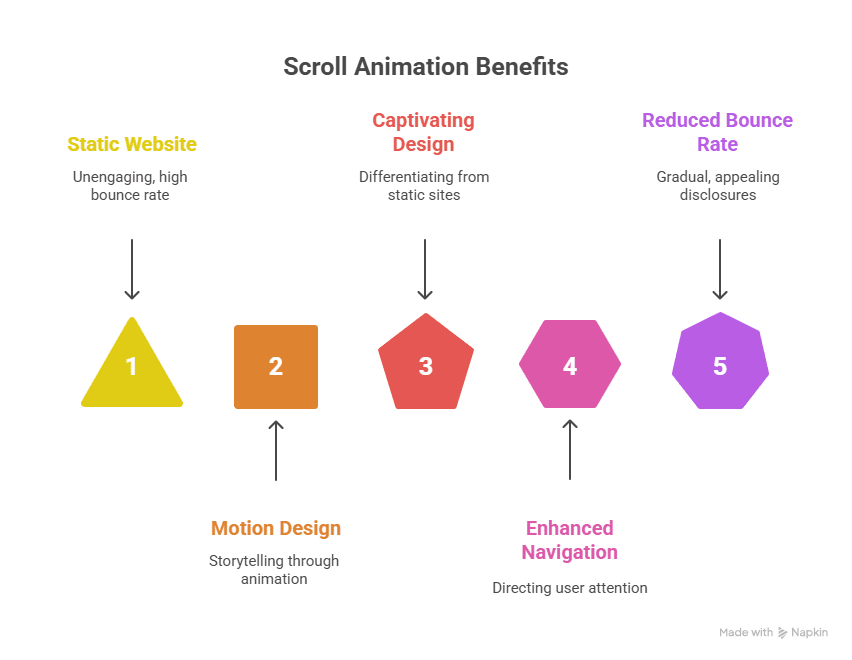
Scroll animation offers several benefits in terms of retaining and converting visitors, offering a superior user experience. For instance:
- It improves brand storytelling through motion design by enabling stories to flow naturally as consumers scroll, increasing story impact and memorability.
- It produces incredibly captivating websites that differentiate themselves from static designs, enhancing the immersive user experience.
- It appreciably enhances navigation and interaction flow while naturally directing users' attention to important material or calls to action.
- It considerably reduces bounce rates by using visually appealing and gradual disclosures to pique users' interest.
- It makes the website feel lively and interactive, which promotes deeper exploration and increases user retention and session duration.
- It consistently reduces initial load time and increases perceived speed by gradually loading and animating content as users scroll.
Applications of Scroll Animation in Custom Web Development
Scroll animation can be flexibly adapted well across various industries and website types. Here are some of its main applications:
Corporate Websites
Scroll animations can be powerful tools for corporate websites as they effectively showcase milestones, timelines, and brand stories in an engaging, visually dynamic way. Such a visual storytelling format feels intuitive, memorable, and immersive— keeping users longer on a company website.
A great example is the iCAUR website portal developed by Techies. This site incorporates Apple-inspired, sophisticated scroll animations that highlight key content whilst balancing youthful energy with professionalism.
During development, the idea was to engineer the animations to be smooth and responsive to enhance the user experience rather than detract from it. Consequently, the website saw appreciably improved site engagement metrics as users spent 40% more time exploring the website.
Product Showcases
E-commerce brands and product-focused companies can exploit scroll animations to showcase product features. For instance, parallax effects can demonstrate product functionality while zooming and fading can spotlight details.
Relatedly, scroll triggers can reveal specifications step-by-step. Overall, this approach turns passive browsing into interactive discovery, increasing the likelihood of customer appreciation and purchases.
Portfolios & Creative Agencies
For creative agencies with designers and photographers, portfolios must always go beyond static galleries. When smartly deployed, scroll animation can provide immersive presentations of case studies, highlighting creative processes, results, and impact. These story-driven portfolios often leave lasting impressions on potential clients or employers.
Landing Pages
Landing pages are natively designed to capture leads or drive sales. Scroll animations can appreciably enhance the functionality of landing pages by:
- Making calls-to-action more noticeable (subtle animations make buttons, forms, and promotional content more noticeable)
- Highlighting product benefits dynamically.
- Building anticipation as users scroll to the conversion point.
Overall, scroll animations can result in boosted engagement and maximised conversion potential. Furthermore, when integrated into custom web development, scroll animations can be customised to fit a brand's identity and needs, thus ensuring a visually appealing and strategic experience.
Best Practices for Scroll Animation Website Development
To ensure scroll animation enhances rather than hinders, website developers are encouraged to follow these best practices to deliver value to both users and businesses. For instance:
- Balance animations with performance: Excessive animation can slow downloading times. So, always optimise code and assets for speed.
- Ensure responsiveness: Iteratively test animations across disparate devices and browsers for behavioural consistency.
- Design with purpose: Ensure every animation maintains a functional or storytelling role—not just serves as decoration.
- Prioritise accessibility: Animations should not overwhelm or confuse users with disabilities.
- Test user flows: Always confirm that animations appreciably help navigation rather than distract from it.
- Keep animations subtle: Smooth, minimal motion usually works better than flashy effects.
- Leverage scalable frameworks: Use reliable web development libraries and tools to ensure stability.
Why Does Choosing the Right Web Development Company Matter?
Scroll animation is a powerful tool to have in one’s website arsenal. However, it requires methodical execution by competent experts who balance creativity with technical skill. In fact, identifying the right web development company directly influences the success, quality, and effectiveness of scroll animation execution for several reasons, namely:
- Technical know-how: Professionals understand how to optimise performance and create responsive designs.
- Creative vision: Experienced developers design animations that align with your brand story.
- Scalable solutions: Proper development keeps animations stable as your site grows.
- Strategic alignment: The right partner expertly tailors scroll animations to drive conversions, not only for aesthetics.
- Ongoing support: Reliable companies offer updates, maintenance, and performance improvements. For businesses in Malaysia and beyond looking for a trusted partner, Techies focuses on blending custom web development with engaging scroll animation features.
Conclusion
In today’s fast-paced digital world, websites must go beyond providing static information. They need to intuitively capture attention, create immersion, and keep users invested.
Unlike static web pages, scroll animation leverages visual motion and interactivity to tell stories, retain attention, highlight products, and guide navigation. These animations may vary from simple effects like parallax backgrounds to complex sequences that transform ordinary browsing into an immersive journey.
This not only captures attention but also encourages deeper exploration. Thus, making websites more memorable and reducing bounce rates. Beyond creating a more responsive browsing experience, scroll animations also lead to higher engagement and satisfaction.
To effectively leverage scroll-triggered elements, parallax effects, and visual motion, consider partnering with Techies. We specialise in curating tailored websites with sophisticated scroll animations that align perfectly with brand identity and enhance digital presence and user engagement.
About Author
Kok Weng
Kok Weng Kong is a tech enthusiast and problem-solving expert with a passion for technology and innovation. As the Founder & CEO of Techies App Technologies Sdn. Bhd., he specializes in building beautiful web and mobile applications and providing branding and marketing solutions for businesses. With a background in Information Technology and extensive experience in the industry, Kok Weng Kong excels in creating innovative solutions for various tech challenges.


Digitizing businesses since 2017


© 2026 Techies | All rights reserved