
Native Apps vs Cross-Platform Development: Which Technology Stack Should Your Business Choose?
 By Kok Weng•Published at 22 Dec, 2025
Key Takeaways
- Choosing between native and cross-platform app development is a strategic business decision, not just a technical one.
- Native apps offer top performance, smoother animations, and deeper hardware access — ideal for complex, high-performance apps.
- Cross-platform apps save time and cost with one shared codebase that works across iOS and Android.
- Frameworks like Flutter and React Native now deliver near-native speed and rich UI, narrowing the performance gap.
- Evaluate your audience, project scope, budget, and feature complexity before deciding.
- Native suits apps needing heavy system integration or platform-specific features; cross-platform fits MVPs and fast rollouts.
- Consider long-term maintenance, scalability, and framework evolution when planning your stack.
Introduction
Mobile apps are now at the heart of modern business. From e-commerce to education and delivery, users expect high-performance experiences every time they tap their screens.
As such, most brands face intense pressure to deliver apps that stand out in functionality, speed, and usability. Consequently, this translates into one big decision—which mobile app technology stack to choose.
Choosing the right mobile app technology stack is no longer just a technical decision. It’s a strategic move that defines a company’s competitive edge in the marketplace. Should you invest in native apps, built for each platform? Or go for cross-platform development, where one codebase powers both iOS and Android?
Generally, different prospective development pathways may affect your app’s speed, time to market, aesthetic, development cost, and long-term maintainability.
What Is Native App Development?
Native app development fundamentally refers to the methodical process of engineering mobile apps specifically for a single operating system—either iOS or Android.
For iOS, this typically involves leveraging platform-specific languages like Swift or Objective-C, while Android apps revolve around utilising Kotlin or Java.
In practice, these languages are designed to integrate deeply with their respective platforms and development tools. For example, Xcode for iOS and Android Studio for Android. Thereby, ensuring that the app is highly optimised to run efficiently on the target device.
Generally, native development gives one full control over the app’s performance and appearance. One can tap directly into device hardware such as cameras, GPS, and sensors. This capability consequently enables maximum performance and smoother animations.
From a user experience view, native apps follow each platform’s design rules—iOS Human Interface Guidelines and Android’s Material Design. As a result, navigation is more intuitive and consistent for users.
Overall, native app development is best for:
- Apps that need high performance (like gaming or video streaming).
- Complex features such as real-time tracking or offline sync.
- Immersive experiences where every animation and transition matters.
What Is Cross-Platform Development?
Cross-platform development allows one app to run on Android and iOS from a single codebase. The idea is that instead of building two separate apps, developers write code and logic once and deploy to both iOS and Android—appreciably reducing development time and costs.
Frameworks like React Native, Flutter, Xamarin, and Ionic are popular choices for cross-platform development. This is principally because they enable shared code resources, better streamlining the development process and minimising duplication of effort.
The primary benefits of cross-platform development are faster deployment and reduced costs due to shared resources and code reusability. Engineering a single app that works across multiple platforms generally simplifies maintenance, accelerates updates, and broadens market reach.
For example, a Flutter app development company can create beautiful, consistent apps with near-native visuals. Meanwhile, React Native development teams in Malaysia often leverage the framework’s community support and rapid iteration capabilities.
Native vs Cross-Platform: A Quick Comparison
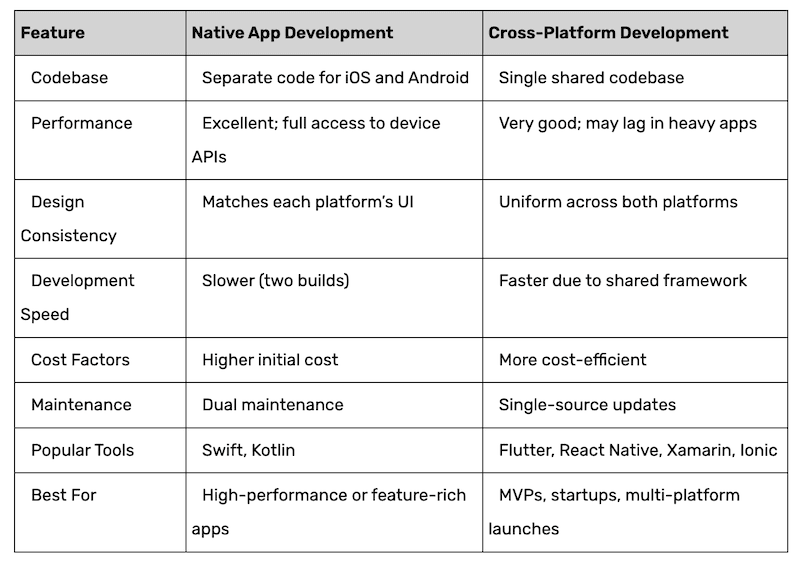
User Experience Considerations: Native Apps vs Cross-Platform Development
User experience isn’t just about visual design — it’s about how an app feels and reacts. Native apps respond instantly because they’re built for the device’s own system. This characteristic enables optimal utilisation of system resources and native animations. Scrolling is smoother. Gestures feel natural. Animations blend perfectly with system motions.
Cross-platform apps, however, win in consistency at scale. A single interface across heterogeneous devices ensures every user has a uniform experience.
Recent advances in frameworks like Flutter have narrowed the gap in UI quality between native and cross-platform apps. In fact, Flutter's rendering engine and customisable widget system allow developers to create aesthetically rich, highly performant interfaces that resemble native UI closely.
Cost Factors and Development Timeline: Native Apps vs Cross-Platform Development
Budget and time often impact technology choice. For context, native apps usually need two separate developer teams—one for iOS, one for Android. That means more cost and a longer timeline. Testing and updates must also happen twice.
Cross-platform apps streamline this. A single team builds once, tests once, and deploys to both systems. This appreciably shortens the project timeline and reduces cost.
Case Study Examples (Techies)
Techies have delivered mobile app solutions across industries using both native and cross-platform stacks. Here’s how their approach matched each client’s goals.
1. SPARQ Coffee Mobile App (Coffee-ordering/delivery) Techies built the SPARQ Coffee app for both iOS and Android using a cross-platform framework. The goal: reduce time and cost while maintaining smooth ordering and delivery tracking—with extensive customisation options.
Results: Faster rollout, easy updates, and consistent UX on both platforms.
2. LADAP Plus Education Mobile App (Education / professional development) Designed for a large Malaysian user base, the LADAP Plus app focused on learning management and offline access. Fundamentally, this app showcases how native-level user experience and performance augment education and professional development apps. It also underlines when native app features and UX principles are preferred for complex projects.
The result: Highly responsive performance, intuitive design, and smooth offline functionality.
3. IDW Super App Design & Build (E-commerce/marketplace super-app) Delivered within a tight 3-month deadline, the IDW Super App combined e-commerce, renovation tracking, and payments.
Techies adopted a cross-platform stack for faster development and integration. It illustrated balancing development speed, architecture choices, and technology stack decisions to meet critical launch timelines and business goals.
Outcome: On-time delivery, unified design, and scalable architecture.
Overall, these examples showcase how Techies’ expertise in mobile app technology stacks helped each business meet its strategic goals. For example, balancing cost, performance, and launch timelines.
When to Choose Native App Development?
Choose native app development if:
- You want the best performance and direct hardware access.
- Your app includes complex animations, real-time data processing, or AR/VR capabilities.
- Your audience is platform-specific, such as enterprise iOS users or niche Android groups.
Overall, native apps are best suited for projects where user experience, hardware utilisation, and performance are critical. Native development is also better when long-term scalability or deep system integration (like Apple Pay) matters to the product.
When to Choose Cross-Platform Development?
Choose cross-platform development if:
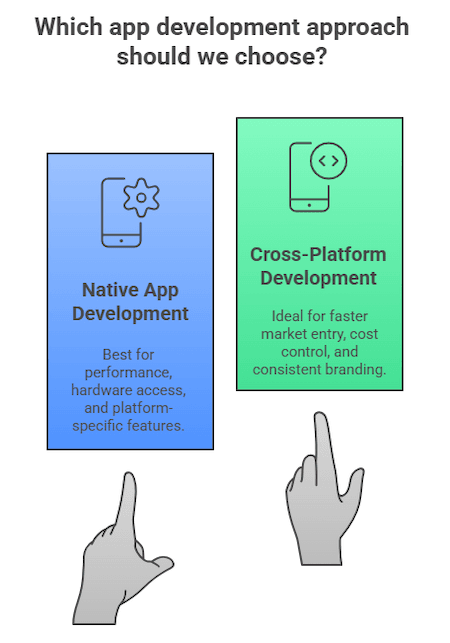
- You want faster market entry with one shared codebase.
- You’re building an MVP (Minimum Viable Product) to expeditiously test demand.
- You target both iOS and Android users with consistent branding.
- You need to control development costs while maintaining solid UX.
Generally, if your goal is speed, efficiency, and reach, the cross-platform development is a no-brainer. This approach suits startups and growing companies that value flexibility and frequent updates.
Technology Evolution: How Frameworks Are Changing the Game
Mobile development frameworks are evolving fast. The performance gap between native and cross-platform is smaller than ever.
For context, React Native leverages JavaScript to deliver near-native performance with extensive third-party plugins. Flutter’s custom rendering engine currently offers outstanding UI consistency and fast animations. Xamarin compiles to native code utilising C# and integrates deeply with Microsoft tools.
In fact, advancements in APIs, plugins, and rendering tools are now making cross-platform apps smoother and more powerful. For example, improvements allow apps to access native device features more seamlessly and maintain high responsiveness. Thereby, reducing previous trade-offs tied to cross-platform solutions.
Many businesses choose React Native development in Malaysia for rapid rollouts and strong community support. Others partner with Flutter app development companies for scalability and beautiful UI design.
In short, technology evolution is turning cross-platform into a credible, long-term choice for both startups and large enterprises.
How Techies Mobile App Development Company Helps You Choose the Right Technology Stack
Techies is a leading mobile app development company in Malaysia, experienced in both native and cross-platform frameworks. We don’t apply a one-size-fits-all solution. Instead, each project begins with a clear review of:
- User experience considerations: How users interact and what performance level they expect.
- Cost factors: Balancing upfront cost and long-term ROI.
- Technology evolution: Choosing frameworks that stay relevant.
- Maintenance and support: Ensuring apps remain stable and scalable. Furthermore, Techies’ experienced developers are highly skilled in React Native, Flutter, Xamarin, and Ionic, along with native tools like Swift and Kotlin. They ensure every app is visually appealing, high-performing, and built for growth—whether through native or cross-platform development.
By aligning the mobile app technology stack with business goals, Techies focuses on helping clients flexibly scale and execute complex functionality whilst maintaining reliable performance after launch.
Conclusion
All things considered, choosing between native and cross-platform development is one of the most important decisions for any mobile project. However, the choice of the right mobile app technology stack largely depends on one’s unique performance goals, target audience, and budget constraints.
Both native and cross-platform approaches offer distinct advantages. Native offers peak performance and perfect system integration. Cross-platform offers speed, cost control, and broader reach. There’s no single “best” answer—only what fits your business goals, timeline, and budget.
For some, native ensures precision and power. For others, cross-platform delivers value and agility.
As such, to make the right choice, it’s imperative to consult a trusted mobile app development company in Malaysia like Techies. Our team can help you identify the right technology stack and framework—ensuring your app not only works, but wins in the market.
About Author
Kok Weng
Kok Weng Kong is a tech enthusiast and problem-solving expert with a passion for technology and innovation. As the Founder & CEO of Techies App Technologies Sdn. Bhd., he specializes in building beautiful web and mobile applications and providing branding and marketing solutions for businesses. With a background in Information Technology and extensive experience in the industry, Kok Weng Kong excels in creating innovative solutions for various tech challenges.


Digitizing businesses since 2017


© 2026 Techies | All rights reserved