
Custom Compliance e-Invoicing Software Development for Malaysian Businesses

Key Takeaways:
- Malaysia’s LHDN e-invoicing mandate is compulsory, with phased rollout through 2026.
- Businesses must submit real-time, structured invoices via MyInvois (API or portal).
- Manual and legacy systems are non-compliant, increasing audit and rejection risks.
- Custom e-invoicing software ensures compliance, automation, and scalability.
- API integration with MyInvois enables seamless validation, UUID generation, and audit trails.
- Early adoption helps businesses avoid penalties, delays, and operational disruption.
Introduction
Every business sends invoices. However, sending compliant invoices is tricky for most. In fact, in Malaysia, the rules around invoicing are changing fast.
The tax authority, LHDN, currently dictates that businesses submit invoices through a government portal in real time. This clearance model seeks to enable authorities to track transactions more accurately, reduce invoice fraud, and address underreporting. As such, businesses that refuse to adapt risk fines, failed submissions, and audit risks.
So, how does one adhere to this nascent strict compliance requirement? E-invoices must follow specific formats and data fields set out in IRBM guidelines. How do businesses enforce this?
This article seeks to explain what e-invoicing means for Malaysian businesses. It also explores what the law requires and the best way to technologically meet those requirements.
Why Malaysian Businesses Must Prepare for e-Invoicing?
The Inland Revenue Board of Malaysia is methodically rolling out e-invoicing in stages. In practice, businesses with annual revenue above RM100 million were required to comply from August 2024.
The mandate extends to smaller businesses through 2025 and 2026 until it covers all businesses nationwide. Unfortunately, this mandate is far from optional. Invoices must be electronically submitted, validated, and acknowledged to be considered legally valid.
So, what does this mean? Every business that issues invoices will eventually need a system that’s interoperable with LHDN's MyInvois platform. In fact, businesses that don’t quickly adapt face real consequences. Rejected invoices may delay payment, and non-compliant records may trigger audits. Subsequently, penalties will follow.
Bottom line, the need for compliant invoicing software in Malaysia is no longer a future concern. For many Malaysian businesses, it is a current one. This shift supports Malaysia's digital tax agenda.
What Is e-Invoicing and How Does the MyInvois System Work?
Malaysia’s e-invoicing framework revolves around a Continuous Transaction Control (CTC) model mandated by LHDN (IRBM). Rolled out since August 2024 in phases by turnover thresholds, this framework now covers most firms above RM5 million.
In practice, it requires businesses to issue structured digital invoices for B2B, B2C, and B2G transactions via the MyInvois Portal. For context, e-invoices must follow UBL 2.1 XML/JSON formats. Mandatory fields include tax IDs, amounts, and SST details. These fields ensure real-time validation before delivery to recipients to curb fraud and boost tax transparency.
Invoices are validated via LHDN by submitting them pre-issuance to MyInvois for automated checks on syntax, completeness, and tax rules. Afterwards, send a unique identifier and QR code only upon approval.
MyInvois accepts two submission methods. Businesses can use the MyInvois portal directly, or they can connect via API. The API route is faster and supports automation—mission-critical for businesses handling large invoice volumes.
Under the hood, the government API integration enables real-time submission from ERP/accounting systems to MyInvois endpoints. Thereby, allowing automated validation responses within seconds for high-volume operations, without manual steps.
Also read:
Why Businesses Need LHDN Compliant Software Development?
Many Malaysian businesses still run on manual invoicing. For context, staff create invoices in Word or Excel, email them to clients, and file paper copies. This worked for years, but doesn’t work under the new tax regime now.
Manual systems cannot connect to MyInvois. They cannot format data as structured XML. They cannot submit invoices in real time or handle validation responses. Every step requires human intervention—and humans make errors.
Outdated accounting software faces similar problems. Older systems were not built with LHDN's API requirements in mind. To exacerbate issues, many vendors have not updated their products to support MyInvois. Businesses relying on these systems are stuck.
LHDN-compliant software development solves this directly. A purpose-built system formats invoices correctly every time. It connects to MyInvois via a secure API. It programmatically ensures syntax checks, tax rule validation, and QR code generation for audit-proof records.
The risk of non-compliance cannot be overstated. An invoice that isn't validated by LHDN is not a valid invoice under Malaysian tax law. You cannot claim input tax on it. Beyond penalties under the Income Tax Act, your client cannot use it. If you send thousands of non-compliant invoices, the exposure adds up quickly.
Fortunately, a professional customised compliant e-invoicing software mitigates that risk. It builds compliance into one’s business processes so it happens autonomously—not as an afterthought.
Challenges Companies Face When Implementing e-Invoicing
Getting to compliance isn’t always straightforward. Most businesses hit practical obstacles along the way. Let’s unpack some, shall we?
- Integrating Existing Systems: Companies struggle to connect legacy ERPs, accounting software, POS terminals, and CRMs with LHDN's MyInvois APIs. This is primarily due to incompatible data formats and outdated infrastructure.
- ERP, accounting, POS, and CRM integration challenges: Baseline ERP systems or local accounting tools rarely natively output LHDN-mandated JSON/XML schemas. POS and CRM platforms also face issues syncing B2C/B2B distinctions and high-frequency transactions over RM10,000. Thus, risking batch failures.
- Managing High Invoice Volumes: High-volume businesses exceed manual upload limits on MyInvois Portal. This limitation demands automated API submissions that scale without latency during peak periods like month-end closes.
- Scalability for Growing Transaction Data: As firms expand, invoice volumes surge beyond legacy system capacities. Without scalable architectures, businesses hit API rate limits and data storage bottlenecks for audit trails.
- Meeting Data Validation Requirements: Invoices must pass LHDN's syntax, semantic, and tax rule checks before receiving UUID/QR approval. For example, accurate SST, TIN, and MSIC codes. However, incomplete fields trigger mass rejections.
- Ensuring Invoices Pass LHDN Verification Rules: Strict rules for B2B/B2C splits, duplicate detection, and fraud flags demand precise data governance. Even minor errors invalidate entire batches.
Build e-Invoice System in Malaysia: Why Custom Development Works Best
Off-the-shelf e-invoicing solutions often fail to accommodate diverse Malaysian business workflows. A retail chain processes invoices differently from a logistics company. A law firm's billing structure does not look like a manufacturer's.
For the most part, off-the-shelf e-invoice tools apply generic templates that overlook sector-specific needs like fintech SST calculations. Furthermore, these packaged tools typically impose rigid UBL 2.1 mappings and limited API customisations. They also tend to clash with high-volume B2C/B2B splits required for MyInvois validation.
Custom development excels by tailoring e-invoice systems to a business’s exact operational workflows. Validation rules are tuned to their data. Integration connects directly to the systems they already use. Custom e-invoicing systems also scale. As your business grows, the software grows with it. When transaction volumes increase, new entities are added. Thereby, minimising rejection risks, optimising audit trails, and future-proofing compliance.
Key Features of Compliant Invoicing Software in Malaysia
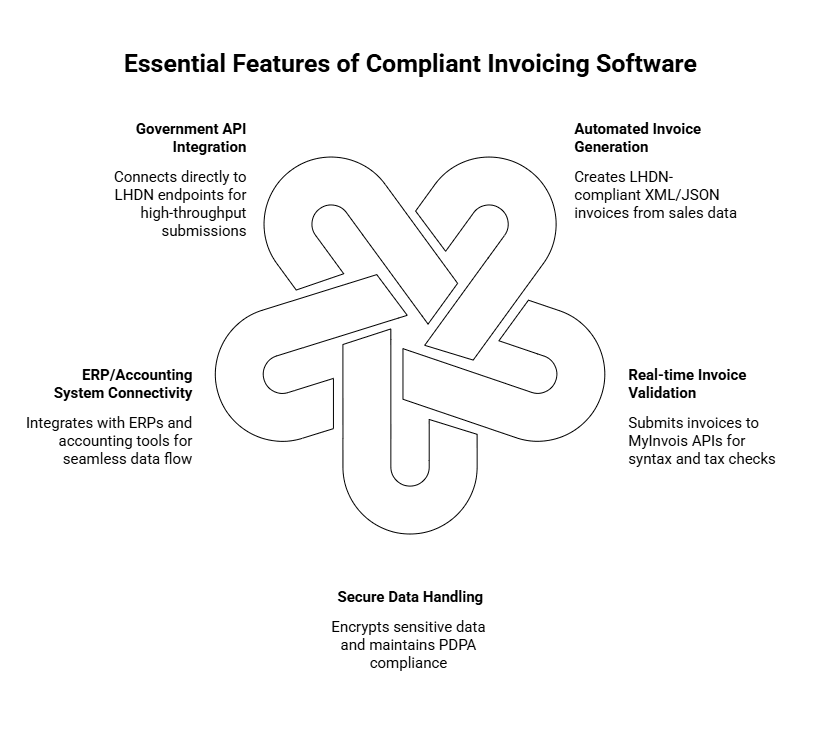
Image: Essential features of compliant invoicing software
A strong compliant e-invoicing solution in Malaysia must include several core capabilities. Let’s break them down, shall we:
- Automated invoice generation: The system should create LHDN-compliant UBL 2.1 XML/JSON invoices from your existing sales data. It should populate mandatory fields like TIN, MSIC codes, and SST details to eliminate manual errors.
- Real-time invoice validation: It should submit invoices instantly to MyInvois APIs for syntax, semantic, and tax rule checks. It should also retrieve UUID/QR codes only on approval to prevent invalid issuances and handle rejection feedback loops automatically.
- Secure data handling and audit trails: Compliant invoicing software should encrypt sensitive transaction data with compliance to PDPA standards. It should also log every validation step for immutable LHDN audit trails.
- ERP / accounting system connectivity: It should integrate bidirectionally with ERPs like SAP or local accounting tools via APIs. It should also automate ledger postings from validated invoices, minimising reconciliation efforts.
- Government API integration with MyInvois: Compliance invoicing software should provide direct, authenticated connections to LHDN endpoints. Beyond pre-issuance validation, this supports high-throughput submissions without portal logins.
e-Invoice API Integration Malaysia: Connecting Your Systems to MyInvois
E-invoice API integration in Malaysia enables seamless submission to LHDN by linking business systems directly to MyInvois endpoints. Thereby, automating the transmission of structured UBL 2.1 invoices for pre-issuance validation.
In practice, businesses generate invoices in their ERP or accounting software. The API then formats, authenticates, and pushes them to LHDN in real-time. It then retrieves UUIDs and QR codes upon approval to confirm compliance before delivery to recipients.
Synchronising data between ERP, accounting, and invoicing systems occurs via bidirectional API flows. These API flows pull customer details, tax codes, and transaction data to auto-populate compliant fields whilst pushing validated results back for ledger updates.
Relatedly, secure authentication layers protect submissions from tampering. By the same token, validation layers enforce syntax/semantics checks to guarantee only approved invoices proceed. This setup appreciably minimises errors, maintains PDPA-compliant audit trails, and future-proofs against LHDN schema changes.
**Also Read: **
Enterprise e-Invoicing Solution Malaysia: Integrating Across Business Systems
Large businesses do not run on one system. They run on many. An enterprise e-invoicing solution in Malaysia must synchronise all of them. Let's illustrate how this would work in practice.
- ERP platforms: These systems typically hold purchase orders, inventory data, and financial records. The e-invoicing system should be capable of pulling this data to generate accurate invoices without re-entering figures.
- Accounting software: Whenever LHDN validates an invoice, that confirmation must flow back to accounting automatically. This keeps financial reports accurate in real time.
- POS systems: These systems generate sales data at the point of transaction. POS e-invoicing integration means invoices are automatically created and submitted as transactions happen.
- Inventory management systems: Enterprise e-invoicing ensures that inventory and delivery records match invoice line items—reducing disputes and failed validations.
- CRM platforms: These systems hold customer details. Accurate buyer information is required for every LHDN submission. A CRM e-invoicing integration means this data is always current and pulled directly, rather than typed manually.
Benefits of Custom e-Invoicing Software for Malaysian Businesses
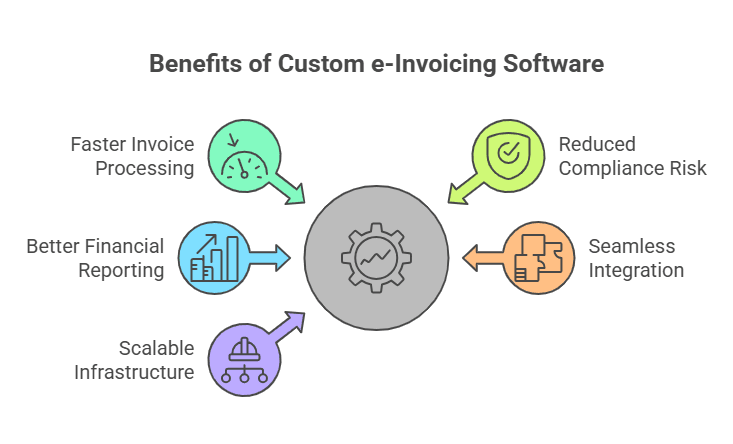
Image: Benefits of customised e-Invoicing Software
Business entities that invest in a well-built custom e-invoicing system see benefits across the operation. For instance:
- Faster invoice processing: Invoicing automation appreciably reduces the time from transaction to submission.
- Reduced compliance risk: Built-in validation and direct API integration mean fewer rejected invoices. Your compliance record stays clean, and audit exposure drops.
- Better financial reporting: When invoicing, accounting, and ERP data stay in sync, discrepancies surface earlier.
- Seamless integration with existing systems: No need to replace or switch your existing platforms. The invoicing layer sits on top and communicates with everything beneath it.
- Scalable infrastructure: New business units, new markets, and new product lines can be added without rebuilding from scratch.
Why Businesses Choose Techies for e-Invoice Software Development?
Techies possess vast experience in custom software and API integration, building for businesses that need more than a template. We expertly develop compliant invoicing systems designed specifically for Malaysia's regulatory requirements.
From e-invoice API integration with MyInvois to ERP connectivity, our solutions are built around how your business actually operates. We handle e-invoice API integration in Malaysia across authentication, data formatting, submission handling, error management, and response processing.
Furthermore, every engineered architecture is designed to scale as one’s transaction volumes grow. Beyond the build, the team provides ongoing compliance support as tax rules evolve.
Conclusion: Preparing for Malaysia’s Digital Tax Future
e-Invoicing is now part of doing business in Malaysia. It isn’t a choice companies can defer indefinitely. The rollout is phased, but the direction is set. Every business that issues invoices will need a system that connects with LHDN.
The businesses that move now gain an advantage. They get their systems right before the deadline pressure hits. They avoid the compliance gaps that come with last-minute panic. They build a foundation that supports accurate reporting and clean audit records.
Custom compliant invoicing software in Malaysia gives businesses exactly that— an LHDN interoperable system built for their proprietary workflow and ready to grow with the business. If your business needs to get compliant or wants to replace an outdated invoicing process, now is the time to act.
Contact us at Techies to get started on future-proofing your company and minimising risks in an evolving digital tax landscape.

Digitizing businesses since 2017


© 2026 Techies | All rights reserved