
How AI Integration in Healthcare Mobile Apps Can Benefit Users
Key Takeaways
- AI transforms healthcare apps from reactive tools to proactive health companions.
- Predictive analytics helps detect risks early, before symptoms worsen.
- Real-time tracking + wearables enable continuous health monitoring.
- AI assistants provide reliable symptom guidance and reduce misinformation.
- Smart scheduling & records improve access, efficiency, and patient experience.
- Despite benefits, data privacy, compliance, and accuracy remain critical challenges.
Introduction: Why AI Integration in Healthcare Mobile Apps Is Transforming Patient Experience
AI integration in mobile apps is seismically reshaping digital health services. Healthcare used to involve unnecessary back-and-forth, including paper forms and phone calls.
However, today, an AI app can track one’s heart rate, flag a health risk, and autonomously book a doctor's appointment. These apps no longer just store information. They think, learn, and expeditiously respond.
In fact, AI-driven health tools programmatically leverage individual patterns—like lifestyle, genetics, or medical history—to offer customised insights. For example, medication reminders or dietary advice to empower self-management.
In the grand scheme of things, this shift has moved healthcare from a reactive, clinic-based model to a proactive one. Thereby, fostering a more patient-centric approach that enhances engagement and outcomes across diverse populations.
What Does AI Integration in Healthcare Mobile Apps Actually Do?
In practice, AI integration in healthcare mobile apps revolves around machine learning algorithms and neural networks. These systems process data inputs via trained models that identify patterns and respond.
As an illustration, every time you log a symptom, record a meal, or check your blood pressure, the AI learns something. Over time, it builds a ‘picture’ of your health to deliver actionable feedback.
For context, this ‘picture’ powers several key tools like:
- Real-time tracking: To watch your vitals continuously.
- Predictive analytics: To spot changes that suggest a disease may be forming.
- Symptom analysis: To suggest causes, flag warning signs, or tell you when to see a doctor.
- Virtual assistants: To handle non-emergency questions and respond with relevant information.
All this revolves around AI’s ability to process large amounts of health data expeditiously. While a human clinician sees you for fifteen minutes, an AI app can monitor you around the clock. The result is better patient outcomes and potential risks getting flagged earlier.
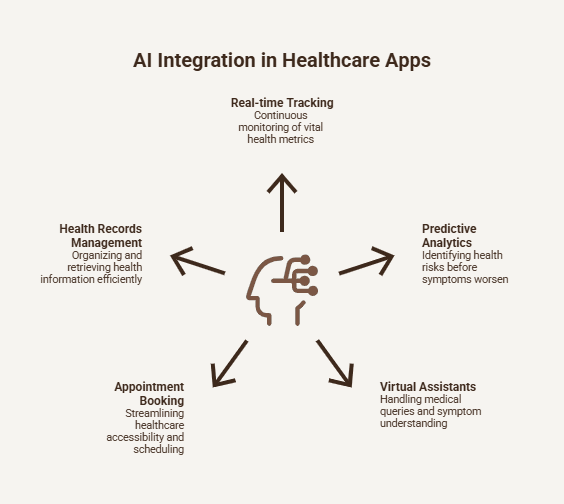
Image: Benefits of AI integration in Healthcare
Predictive Analytics Helps Identify Health Risks Before Symptoms Worsen
Unfortunately, bad news never has good timing. In essence, most health problems do not arrive without warning. Blood pressure creeps up. Sleep gets worse. Activity drops.
However, predictive analytics programmatically ‘reads’ these signals. In practice, it evaluates one’s health data across time to pinpoint patterns that match known health risks. When it spots a match, it intervenes to alert the user or a care team. Better yet, it offers custom insights on actionable plans to mitigate the risk.
This kind of early warning is invaluable, especially as people age and get busier. It gives them time to act before symptoms worsen.
Overall, the biggest benefit of predictive analytics isn’t the ‘prediction’ itself. It is what users do with the interventive predictive insights. In fact, AI doesn’t replace the doctor; it helps users arrive at the doctor better prepared. It shifts patients from being passive to active participants in their own health.
AI Can Assist Users with Medical Queries and Symptom Understanding
Let’s be honest, most people have Googled their symptoms at a certain point. The results are often unhelpful, scary, or both. Fortunately, AI-powered virtual assistants inside healthcare apps offer a better alternative.
Unlike typical AI customer service agents, these assistants are trained on medical data. As a result, they programmatically ‘comprehend’ most symptoms and conditions. In practice, this consequently enables them to guide users through health concerns with structured responses.
For example, if you report a sore throat, mild fever, and fatigue. The assistant might list likely causes. Afterwards, it might suggest home care steps. Or even tell you which symptoms would mean you need to see a doctor. That guidance is calm, clear, and specific to what you described.
Furthermore, some apps maintain triage features. Generally, these help you decide how urgent your situation is. Should you rest at home? Call your doctor? Go to a clinic today? AI triage features help you figure that out without guesswork.
Real-Time Tracking: Monitoring Health Data Continuously
Real-time tracking in healthcare mobile apps revolves around the continuous monitoring of vital health metrics. This is typically facilitated by seamless integration with wearables like smartwatches, continuous glucose monitors (CGMs), and fitness bands.
In practice, these devices stream and log data on heart rate, blood glucose levels, sleep patterns, and activity levels directly to the app. This constant stream empowers users to proactively observe their health trends over time. For instance, detecting irregular heart rhythms during rest or spikes in glucose post-meal. Such consistent oversight appreciably reduces dire health risks and improves daily management.
AI-powered systems programmatically analyse this influx of data in real time to spot anomalies and generate personalised alerts. They can also exploit this data to deliver actionable insights, such as optimised workout suggestions.
For the most part, secure wearable integrations like Apple Watch and Fitbit ensure secure data syncing. Thereby, enabling comprehensive profiles that adapt to individual baselines. This closed-loop monitoring enhances early detection and reduces oversight risks.
AI Can Improve Appointment Booking and Healthcare Accessibility
Booking a doctor's appointment might sound simple. However, it practically involves phone calls, hold times, mismatched schedules, and forgotten reminders. Fortunately, AI removes most of that friction.
AI-powered scheduling reads your calendar, checks available appointment slots, and books the best match. Furthermore, it sends reminders ahead of time and reschedules if something changes. It can even flag when it has been a while since one’s last check-up.
For healthcare providers, this appreciably cuts admin work. Fewer missed appointments. Fewer phone calls. Better use of available slots. For patients, it means less waiting and more personalised care.
Some AI smart calendar optimisation features can also learn over time. For example, it can note the times you tend to cancel or notice when you prefer morning appointments.
Smarter Health Records Management with AI
Paper records often get lost. Relatedly, digital records can get buried in digital drives or archives. Bottom line, finding the right information at the right time has always been a challenge in healthcare!
AI radically changes this by organising records automatically. When one receives test results or uploads a prescription, AI categorises that information and stores it in the right place. It also parses unstructured text into standardised categories like diagnoses, medications, or allergies. Thereby, eliminating manual filing errors.
By the same token, AI Features like automatic categorisation tag entries by date, type, and relevance. Rapid data retrieval employs semantic search to pull specific details instantly. Relatedly, AI summarisation condenses lengthy patient histories into key event overviews for quick reference.
Overall, AI-powered systems enhance data accessibility for patients, empowering self-review without technical hurdles. For doctors, it is equally useful. Whenever a patient shares their app records before a visit, the doctor arrives with context.
Challenges of AI Integration in Healthcare Apps
Like most emerging verticals, AI integration in healthcare mobile apps is not without significant challenges.
Privacy is the first. Health data is deeply sensitive and personal. As such, users need to know their data is stored securely, used ethically, and never shared without consent. A data breach in a healthcare app can put people at risk.
Regulatory compliance adds another layer of complexity. Healthcare is one of the most regulated industries in the world. This is with good reason, given the aforementioned sensitivity. That being said, apps that influence medical decisions must meet strict legal standards to avoid penalties.
Data accuracy remains a hurdle, too. AI models trained on biased or incomplete datasets can produce flawed predictions. This can consequently lead to instances of misdiagnosed symptoms, potentially eroding trust and leading to harm.
Nonetheless, these challenges do not make AI unsuitable for healthcare. They make careful development essential.
Also read: Overcoming the Top 5 Challenges of AI Integration in Mobile Apps
The Future of AI Solutions in Healthcare Mobile Apps
Most times, it is difficult to speculate on the future. However, most evidence suggests that healthcare AI solutions for mobile apps will keep getting smarter. In fact, the direction is clear: what feels advanced today may be routine in a few years.
Predictive diagnostics will continually improve. AI models will get better at spotting early signs of conditions like heart disease, diabetes, and certain cancers. Much of this speculation is driven by the influx of multimodal data we are seeing churned out daily. For example, genomics, lifestyle habits, and real-time biometrics.
Relatedly, remote patient monitoring will expand by leaps and bounds. Wearables will track more variables, as well as long-term wellness trajectories. In fact, more advanced neural networks will forecast diseases years ahead from subtle wearable signals.
AI-powered telemedicine will grow to exploit augmented reality for remote exams. Thereby, democratising access and reducing disparities in underserved regions.
Virtual consultations will become smarter, making health management feel preventive rather than reactive. Personalised care plans will become standard. Instead of generic advice, users will receive guidance built around their specific data— at a granular level.
Conclusion: AI Is Making Healthcare Apps Smarter and More Proactive
In conclusion, AI integration in healthcare mobile apps gives ordinary users something they haven’t had before. Consistent, personal, data-driven support for their health.
Predictive analytics helps users pinpoint problems early. Virtual assistants answer questions and guide decisions. Real-time monitoring tracks vitals around the clock. Not forgetting, smarter scheduling that removes the friction from accessing care.
None of these tools replaces doctors. They improve accessibility and early intervention capability. They make the time between visits more productive. They keep users informed whilst helping people arrive at appointments prepared and engaged.
At Techies, we build mobile apps that put these capabilities into practice. So, if you’re considering customised mobile app development for healthcare with AI at its core, reach out to us at Techies.

Digitizing businesses since 2017


© 2026 Techies | All rights reserved