
HTTP vs HTTPS: The Difference And Why It Matters
 By Kok Weng•Published at 29 Jul, 2025
Summary _HTTP and HTTPS are protocols for transmitting data over the web, but they differ in security. HTTP sends data in plain text, making it vulnerable to cyber threats. HTTPS, an extension of HTTP, encrypts data using SSL/TLS, ensuring secure communication and protecting sensitive information. _
Google prioritises HTTPS sites in search rankings, making it essential for businesses to adopt it for security, SEO benefits, and compliance with regulations like GDPR. Migrating to HTTPS involves obtaining an SSL certificate, updating website links, and setting up redirects. Secure your website with HTTPS to enhance user trust, SEO performance, and data integrity.
Introduction
Because cyberattacks are becoming increasingly common in today's digital environment, website security cannot be ignored.
To counteract cyberattacks, HTTPS has emerged as the industry standard for safe websites. It extends the basic HTTP protocol, enabling data protection during transmission between a user's browser and the web server.
In fact, Google prioritises HTTPS sites in their rankings. As such, it is imperative that website owners adopt this protocol to improve visibility and comply with data protection regulations.
However, despite HTTP and HTTPS being foundations of web communication, the distinctions between both protocols are often misunderstood. While they share similar functionalities, they maintain stark differences in security measures.
What is HTTP?
HTTP (or Hypertext Transfer Protocol) is the baseline protocol for data transmission across the World Wide Web. In practice, it defines a set of guidelines for how web browsers and clients interact with web servers to request and deliver resources. For instance, text, photos, and videos.
Key characteristics of HTTP and how does it work?
Put simply, HTTP is a protocol that governs the transmission of data over the Internet. It leverages on a request-response model. In this model, a client sends a request for resources, in turn, the server responds with the requested data.
In practice, this process involves sending and receiving data in plain text. In fact, there is no encryption overhead, which can sometimes allow faster performance. However, while straightforward, this mode of operation is susceptible to interception by malicious actors.
The two key characteristics of HTTP can be summarised as:
- It lacks encryption, exposing it to potential security risks.
- It allows for quicker communication between clients and servers due to no encryption overhead. However, as security concerns have grown in the digital landscape, HTTP is becoming increasingly obsolete in favour of HTTPS (Hypertext Transfer Protocol Secure).
What is HTTPS?
An extension of HTTP, HTTPS (Hypertext Transfer Protocol Secure) offers a safe way to send data over the Internet. It exploits encryption technologies, particularly Secure Sockets Layer (SSL) or Transport Layer Security (TLS). These technologies ensure that online communications between a user's browser and a website are safe from manipulation and eavesdropping.
Key characteristics of HTTPs and how does it work?
HTTPS is designed to protect the integrity and confidentiality of data exchanged between a user's web browser and a website. By encrypting data, HTTPS prevents unauthorised parties from accessing or tampering with the information being transmitted.
As such, it’s a key feature of websites handling sensitive transactions, such as online banking and e-commerce. In fact, HTTPS helps guard against man-in-the-middle attacks, guaranteeing that users can rely on the legitimacy of the websites they visit.
As the industry standard for secure online interactions, the key characteristics of HTTPS can be summarised as:
- Encrypts data to prevent interception by hackers, i.e., renders intercepted information unreadable.
- Displays a padlock icon in browsers, indicating that the connection is encrypted and secure.
- Required for websites handling sensitive data (payments, login credentials). As such, it helps to build user trust and comply with privacy regulations.

What is the difference between HTTP and HTTPS?
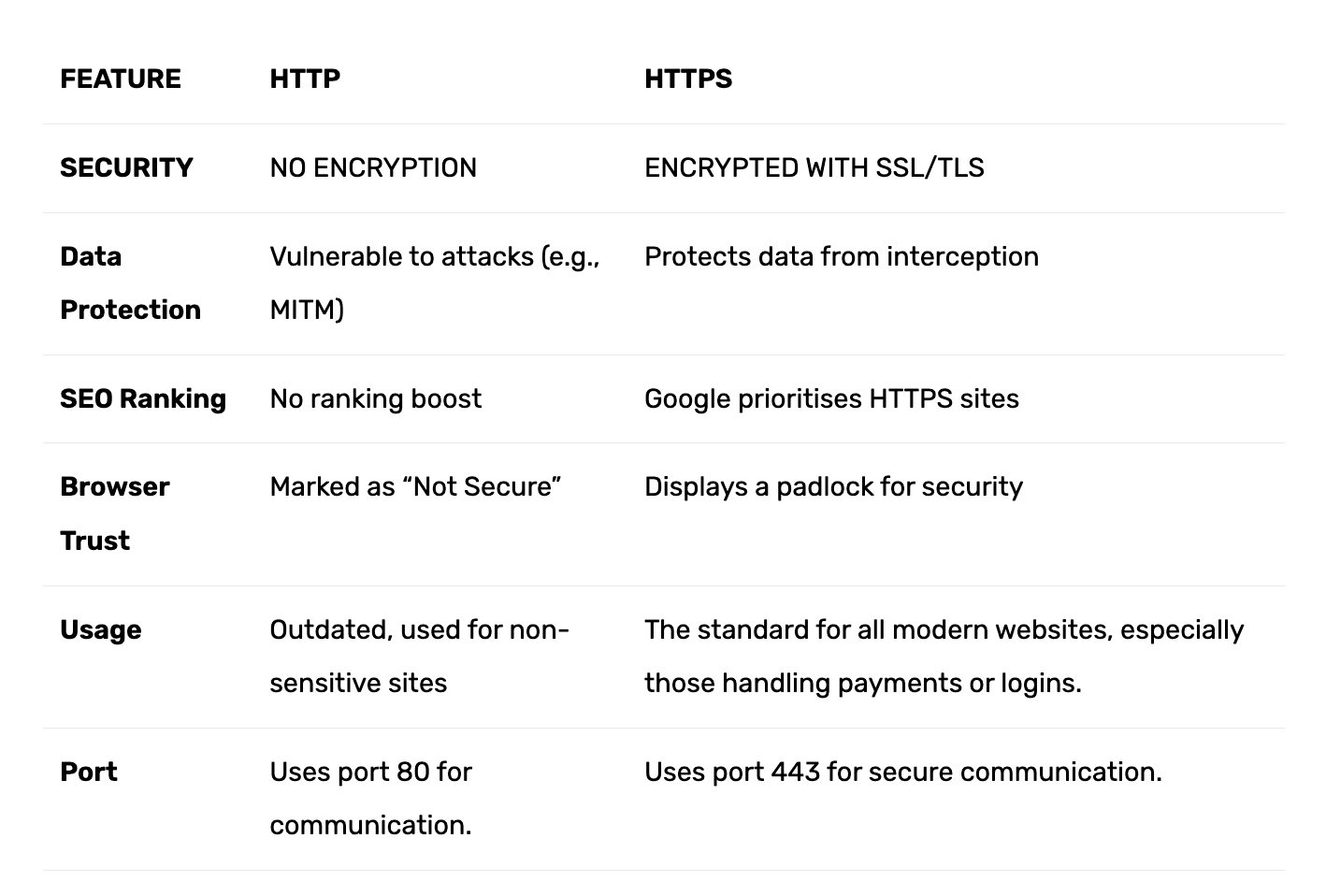
The degree of security that HTTP and HTTPS offer is where they diverge most. HTTPS employs SSL/TLS protocols to encrypt data. This ensures that any information sent between the user and the server is secure and confidential.
On the other hand, HTTP transmits data in plaintext, which leaves it open to interception and attacks. Here is a table to illustrate the distinctions between the two protocols:
Why is HTTP not secure?
The main reason HTTP is insecure is that it sends data unencrypted. This leaves it open to being intercepted by bad actors.
In practice, anyone who manages to intercept a transmission can readily see any data sent between a client and a server. For instance, login passwords and personal information.
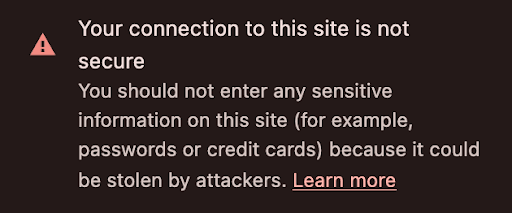
Furthermore, HTTP lacks any means of confirming the legitimacy of the parties involved in the internet communication. This consequently leaves room for a number of threats, including man-in-the-middle assaults. As a result, sensitive information may be compromised— resulting in identity theft and other security breaches.
By using SSL/TLS encryption, HTTPS, on the other hand, fixes these flaws—guaranteeing that data is safely sent and shielded from unwanted access.
Why HTTPS matters?
The existing digital landscape is heavily reliant on HTTPS (Hypertext Transfer Protocol Secure) for a number of reasons, such as:
- Improves security: HTTPS encrypts web data being transmitted, effectively preventing interception by hackers.
- Boosts SEO rankings: Search engines like Google favour HTTPS websites in their ranking algorithms. As such, websites that don’t utilise HTTPS may find themselves at a disadvantage in search results compared to their secure counterparts.
- Builds trust: Ordinary users are more likely to engage with websites that display the padlock icon in the address bar. This indication of a secure connection reassures visitors that their data is safe. Thereby, fostering a sense of trust.
- Ensures compliance: Regulations like the General Data Protection Regulation (GDPR) mandate secure handling of personal data. As such, implementing HTTPS helps businesses reduce the risk of penalties associated with data breaches or non-compliance.
- Better Performance: Modern implementations of HTTPS improve website performance due to advancements like HTTP/2. HTTP2 appreciably enhances loading speeds and overall user experience compared to traditional HTTP connections.
- Data Integrity: The HTTPS protocol ensures that the data sent and received hasn’t been altered or corrupted during transmission. This integrity is mission-critical to maintaining accurate communications between users and websites.

How to migrate from HTTP to HTTPS?
HTTPS isn’t just a technical requirement but a fundamental aspect of maintaining internet user trust and ensuring secure online interactions. To successfully migrate from HTTP to HTTPS to improve your website’s security, follow these steps:
- Obtain an SSL/TLS certificate: Getting an SSL/TLS certificate is the first step in switching to HTTPS. This is necessary to encrypt data that is passed between your server and users. One can obtain these certificates through Trusted Certificate Authorities (CAs) or their web hosting provider. Both free (such as Let's Encrypt) and paid solutions are available.
- Install the certificate on your web server: After being obtained, the SSL/TLS certificate must be installed on your web server. The procedure may differ based on your hosting environment. However, it usually entails setting up the server and uploading the certificate files. Fortunately, most hosting companies provide tools or instructions to help with this installation.
- Update website links to HTTPS: After the certificate has been installed, update all of your website's internal and external links to utilise HTTPS rather than HTTP. This involves changing stylesheets, scripts, graphics, and page URLs. This step is required to avoid mixed content problems when some resources are still loaded over HTTP.
- Set up 301 redirects: Subsequently, 301 redirects can be set up using your server configuration or .htaccess file. These will guarantee that users and search engines are redirected to the secure version of your site— maintaining traffic continuity and SEO rankings.
- Verify and update your Google Search Console settings: Once the migration is complete, add your new HTTPS website as a new property in Google Search Console to validate it. After updating your sitemap to include the new HTTPS URLs, submit it for crawling. This guarantees that your website is appropriately indexed under the secure protocol and aids Google in recognising the modifications.
Conclusion
Although both HTTP and HTTPS are protocols used to send data over the Internet, their security features differ. Because HTTP transmits data in plain text, it is susceptible to interception by bad actors and man-in-the-middle attacks.
HTTPS, on the other hand, leverages encryption via TLS (Transport Layer Security) or SSL (Secure Sockets Layer) to protect the data being sent. As such, it ensures that sensitive information like passwords and credit card numbers are protected during transmission.
Because HTTPS exploits encryption and digital certificates, it helps increase user confidence and SEO (Search Engine Optimization) ranking. This is exemplified by the fact that web browsers frequently display a padlock icon in the address bar to indicate secure connections. Additionally, the broad deployment of HTTPS conforms with regulations such as GDPR.
The right web development service provider is crucial as businesses negotiate the challenges of switching from HTTP to HTTPS.
At Techies, our speciality is delivering all-inclusive web development solutions that enable this shift to happen seamlessly. Explore our web development services and don't hesitate to leave your contact information here.
About Author
Kok Weng
Kok Weng Kong is a tech enthusiast and problem-solving expert with a passion for technology and innovation. As the Founder & CEO of Techies App Technologies Sdn. Bhd., he specializes in building beautiful web and mobile applications and providing branding and marketing solutions for businesses. With a background in Information Technology and extensive experience in the industry, Kok Weng Kong excels in creating innovative solutions for various tech challenges.


Digitizing businesses since 2017


© 2026 Techies | All rights reserved